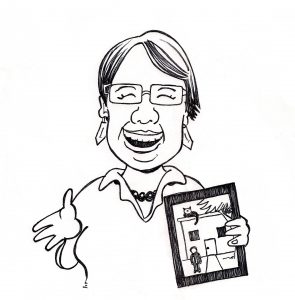
Yenn is 49 – getting older as well as I can

Today, 23 July, is my birthday, I usually celebrate my name day on 20 May but today is also an auspicious day in the Yenn calendar. I was born exactly 49 years ago. Wow! Everyone tells me I don’t look my age. I think that is an autism thing because lots of autistic people look younger than their years. I am not sure why that might be. Someone suggested it may be due to autistic people having more collagen in our bodies but I really don’t know. I am not complaining!

It is hard to imagine that I am 49. I don’t feel 49 – although what 49 is meant to feel like I have no idea! I am supposed to be ‘middle aged’. I have coloured hair are wear art t-shirts and silly shoes so my style doesn’t ‘act my age’ but I can’t imagine a world where I don’t have coloured hair and silly shoes! My style is not about how old I I’m but about my own sense of identity.

I was diagnosed as autistic when I was 20. I was diagnosed with schizophrenia when I was 21 so I have had both diagnoses for most of my life. Life expectancy for both autistic people and those with schizophrenia is significantly lower than those without the conditions which means statistically I probably don’t have much time left. However I have no intention of leaving this planet any time soon. I have way too much to do! 

I actually like being older. Well mostly. I worry that I will turn into one of the ageist older people who mistrusts young people but I am not there yet. I probably have more in common with younger people than older people. I think being non-binary helps with that. A lot of older people can be quite transphobic but I am definitely not that! Well apart form some internalised self-stigma but I am fine with every other transgender person! 

My parents of course are another generation to me entirely. Their friends all seem to be getting old and dying or getting dementia. It really is quite frightening. I worry that my parents themselves all get dementia or cancer for have a heart attack. They are pretty healthy at the moment but I am quite concerned. The other thing I take from my parents’ experiences around ageing is that life ends. You get old and then you die. I have quite a strong understanding of this but it is something I hadn’t really articulated until recently. That will probably be me too. It isn’t all onwards and upwards. Life comes to an end and often when you get to that point you are relieved to leave the world because life is fraught and painful. I had honestly never considered that until recently. Maybe that realisation is an ageing thing too. 

But for now I am not thinking about dying. I am thinking about using my experience and what a colleague described as ‘Yenn’s enormous brain’ to make the world a better place. To use my experience of being around for 49 years to make change, support people and change things for the better. And probably write a book or two!

Medication – Thoughts after 28 years 

I take medication. I have been taking medication for schizophrenia since 1995. I have tried most of the schizophrenia medications and am now on the sort of end of the line drug, called clozapine. More about my good friend clozapine later!

I also takes meds for mood (lithium – since 2011) and anxiety (sertraline since 2021 and should probably have been on it many years before that!) I also have a bunch of physical illnesses requiring daily medication.

Some people think taking medication is a bad thing but not me. I think it is liberating, My various medications have changed my life and made it possible for me to do all the things I do. Without my meds I suspect I would spend my entire life in the psych ward feeling terrified and miserable. With my meds I am able to work full-time and do a bunch of cool things, such as writing this blog and any number of books!

One thing people worry about is medicating kids. I don’t really have a clear cut opinion on this. I know that some kids really need their meds and the medication has completely changed their life for the better so I would not want to deny access to meds for these kids but I do understand parents’ concern around medicating their kids. It is a big decision.

I know some people are against medication completely. I wish I had the luxury to not take mine due to some ideological objection but my schizophrenia and anxiety make that impossible. I don’t hugely care about ‘big Pharma’ if not being medicated means I spend most of my life unwell and psychotic. Psychosis is basically like being in a waking nightmare and not being able to wake up. I wish I was able to morally object to the companies which supply me with my meds but that is not a luxury I have!

So clozapine, Yennski’s lovely clozapine. I spent 46 years of my life not taking clozapine. Of those years I took anti-psychotic medication for 25. I had a baseline of unwellness and was usually frightened of things that most people wouldn’t consider scary. I have lots of episodes of acute illness and life was very challenging. In 2020, as COVID was doing horrible things and we were all locked down, I was in hospital for four months – one of my longest ever admissions. My psychiatrist asked if I wanted to go on clozapine – the last line of defence anti-psychotic drug. All I knew about clozapine was that it has potentially life-threatening side effects and that it made you sleep. I imagined myself as a zombie – a schizophrenic stereotype. I had declined several other doctors’ offers of clozapine in the past but by 2020 after a very scary episode of illness I thought ‘meh, why not?’ It takes a long time to go on clozapine. They start with a tiny dose and work up very gradually. At the start of the process I would as look at the pills in my hand and say ‘please be my good friends little clozapines’. And they actually did become a very good friend.

My illness is less of an issue than it has ever been now. My regular psychiatrist who I have been seeing on and off since 2010 said I am better on clozapine than he has ever seen me. I have not been psychotic since then and I have managed some really stressful situation without getting unwell. Clozapine is a pain though. I have to have blood tests every month and regular heart scans. It makes me sleep for twelve hours every night and I work 9-5 so I don’t really get evenings any more but I actually don’t care as it has changed my life. So, a life changing pain in the butt!

So yes, medication – go the pills! My medication enables me to do all the cool things that I do. I know it is likely I will take the meds for the rest of my life and I am aware they may well shorten my life but quality not quantity in such things I say. 

How my world of work went from woeful to wonderful – navigating the workforce as an autistic person 

The image for this post is my latest book which is all about employment and autism. Employment is a big topic for me and I think for many others. 

You may know that I am now a career civil servant of almost 17 years tenure. This is a good thing and a huge privilege but it was not always the case that my world of work was wonderful.

In February 2000 I was released form prison.  I was living in crisis housing and life was very challenging, Towards the end of 2000 I moved into a house for young people with mental illness. This was actually a big step up from where I had been and I saw it as the start of my new life. When I was there I saw women walking their children in the park. It was a very swanky suburb and these women were not poor. Rather their partners worked and earned enough to pay a million dollar mortgage on one income. I saw them and thought that maybe I too could have  a professional job and pay a mortgage. I wanted to be ‘ordinary’ – which to my mind meant to have an education, a professional job, a mortgage and a suit. Spoiler alert… within eight years of my decision I had all those things! Go me!

It was a very challenging path though. I enrolled in university in 2001 and loved my course. I was a very successful student getting lots of high distinctions and awards. I was invited to join an honour society for high achieving students. At this point I thought employment would be the logical next step. I got myself a job washing dishes in a restaurant. It wasn’t difficult work but it was actually very difficult due to my high anxiety. I worried about work constantly. What would happen if I made a mistake? Would the restaurant go out of business and it would be my fault? The anxiety was so bad that ti turned into psychosis and I went to hospital and had to quit the job. At that point I had a helpful thought – ‘I can’t work NOW but one day I will be able to work.’ This became the mantra by which I lived my life for the next few years. 

I figured that I needed to build my confidence around working. I just went to university for the next couple of years. I then got myself a volunteer role in a gallery which gave me confidence. I then had a very small business shooting and editing videos for my art school colleagues. I then got a job collecting money for an AIDS charity. All these experiences were incremental steps in my journey to my ‘ordinary’ goal. 

In 2004 I met someone who would become a good friend and also a mentor, autism advocate and author Polly Samuel. I met Polly at a course for autistic people so we could give presentations to schools about autism. I have no idea why Polly was there as she was  already an accomplished speaker but she was there and for that I am eternally grateful. 

Polly encouraged me to write my life story I did and it was published and I guess the rest is history. Everything I had done in the preceding years was about building my confidence to work and the book was the final step in that journey. Three months after my book came out I applied for two government graduate roles. I was shortlisted for one and successful for the other and I am still there now. Polly cautioned me about my public service role saying that such jobs were ‘not autism friendly’ to which I replied that maybe I should make the role autism friendly! Actually I have had an amazing time in my job. I think some people would struggle with the hierarchy and processes but I am all good with such things. My job has enabled me to purchase two properties over the years, the nicest of which I live in now. When I started out at work my first pay was four times what my income on government benefits had been! It was completely life-changing.

I think a lot of people when presented with my situation after quitting the dishwashing job would have given up on the idea of work and stayed on benefits. Of course that is a valid decision and people living on benefits should not be disgraced or judged but I wanted to be able to make decisions about where I lived and what I spent my time doing. When I was poor I was acutely aware of this lack of control and I didn’t like it. 

I know I am hugely privileged now in terms of what I spend my time doing and my income. I am so grateful to have the life I do and the job I do. Being an ex-prisoner in such a role is extremely rare and having all my various other intersectional differences is rarer still but that is how it is. My main issue in employment over the years has been anxiety rather than my competence or level of skills. I am still anxious but it is much better than in 2001 when may anxiety around work caused psychosis. I will say that I think my work of work is wonderful. 

Self esteem, pride and the  politics of learning to love yourself 

Content warning: bullying

Yesterday I had lunch with a friend who is an activist in the Disabled community with a big profile. I mentioned a consultancy and what I planned to charge the organisation that booked me. My friend said she would have charged twice what I did. I said ‘but you are more accomplished than me!’ My friend just looked at me and I realised that this was a bit of a foolish statement. I have thirteen published books, a big profile and have given a TED talk – along with hundreds of other talks. I am extremely accomplished and should probably charge a lot more than I do for my advocacy work. I literally sell myself short.

In fact I am a lot better in this space than I have been in the past. I am a Disabled, Queer person with a history of bullying and abuse. As a child there did not seem to be a lot of praise or respect from the people in my life. My family was a safe place but my parents were quite religious and equated pride with being a negative thing similar to arrogance. This meant that I missed out on a lot of praise from family as they didn’t want to promote what apparently was a sin. Outside of family pretty much every peer I had hated me. Bullying was rife and I believed all the horrible things the bullies said. Why wouldn’t I as nobody seemed to want to counter their views. 

I hated myself so much that I actively sought out negative things for myself as a teen and young adult, culminating with me going to prison in the mid-1990s. I wanted death or misery or both and I sought these out. I hated myself and society hated me. The only people who stood by me were my long-suffering parents who never wavered in their love and support. They saved me really for which I am extremely grateful even now almost 30 years later. 

I did the impossible and overcame my life of drugs and crime. I set about making change but my history haunted me and I rarely felt that there was anything good about Yenn. This attitude is not just confined to previous Yenn though. For people who belong to the various intersectional groups self-esteem and loving yourself is almost impossible. We live in a society which degrades Disabled people, Queer people, People of Colour, First Nations peoples, poor people and people from all sorts of other groups. There are low expectations and outright bigotry. To be proud of who you are and have positive self-esteem can be seen as something of a political act. 

I tell myself this as a means to building my self-esteem which is still bit iffy. When people call me an expert or a leader I struggle to agree with them. As an activist and advocate ist is easier to build my self-esteem as a means of addressing broader societal issues rather than making my own life better is an easier thing to do. If I think of valuing and respecting myself as part of my trying to change the world it is easier for me to do. 

Could you imagine a world where marginalised people were all proud of who we are and liked and valued ourselves? It would be wonderful I think and make it a lot harder for people to discriminate against us. Of course the onus for addressing discrimination should not really lie with marginalised people – society is responsible for doing that but self-esteem and pride for marginalised people is definitely a positive and needs to be encouraged.

And yes, I AM an expert, I DO have a lot to offer and I WILL make a difference!  And the same goes for others of course.

The medical model and social model of disability and the future of diagnosis

I was in a meeting of neurodivergent folks last week which involved a panel presentation. One of the presenters spoke about their concerns with the medical model of neurodivergent conditions and why they had not sought a diagnosis but self-identified. This got me thinking about all of those issues around the medical model. 

Basically there is a medical model of disability and a social model. Under the medical model we are seen as being disabled by our health condition. Autism for example is seen as a disorder or a set of deficits to be somehow fixed. There are some ads on YouTube at the moment featuring an autism researcher proudly saying that we can now give very young autistic kids interventions which mean they will no longer have as many autistic characteristics. More about that later…

The social model of disability is the one I prefer. The social model sees society as the main reason for disability. We become disabled by the world we live in – complete with its assumptions, judgement and stereotypes. Under the medical model I am disabled by my neurotype/s. I apparently need some interventions to fix my autistic bits and my schizophrenic bits as they are a deviation from some norm of existence and as such need to be addressed. Under then social model, the world needs to change to support my needs. I do not need fixing but I need understanding, respect and support. 

The idea of a diagnosis of neurodivergent conditions is in and of itself quite problematic. Within the neurodiversity movement there are conversations around the difficulties with medical diagnosis. If we are not broken and do not need to be fixed, the concept of a medical diagnosis is problematic. Will we have diagnoses in the future or will our identity as neurodivergent be seen as a valid difference – much like being LGBTQIA+. I mean we don’t need a diagnosis of gay it is a way people are and they know that they are. It is part of their identity. So similarly, in the future will neurodivergence be an identity in a similar way. I am not sure but it is an interesting thought. 

I am seeing more and more people identifying as neurodivergent and embracing their identity. It is a lovely thing. So how do we reconcile the medical model which at the moment at least is the dominant paradigm, with the social model and the empowerment which comes along with it? Will there be a need for a medical diagnosis in the future? Will autism and other neurodivergent experiences simply be seen as another way of being? 

 I see these issues as being critical at the moment. There is a disagreement between the medical model and the social model (cue autism researcher from the start of this piece proudly saying how his organisation can make kids less autistic). These things are getting more and more fraught and heated. 

I want a world where autistic people are accepted and supported to be ourselves. I do not see a world where all the autistic kids have been ‘fixed’ as a good thing. I strongly believe that autistic and other neurodivergent folks offer the world amazing things. We have the right to exist as we are and we are perfectly valid the way we are. I don’t want to be fixed. My autism is a big part of what makes me who I am and I am Yenn Purkis – as far as I can tell a lot of other people like me just the way I am as well.     

No reason for shame – thoughts on  being overweight 

I am fat. I have been fat for many years now. It is part of who I am. 

Growing up I learned a lot of unhelpful stereotypes around body shape. Fat people had ‘let themselves go’. Fatness was seen as a reason for judgement and blame. 

I have seen fatness being listed as an intersectional / equity group due to the huge amounts of prejudice and judgement around it.

The main reason I am fat is the medication I take for schizophrenia. If I did not take this medication I would be unable to live the life I do. Plus I would be inhabiting a waking nightmare. I would be terrified and probably permanently institutionalised. So when someone says something rude about my weight I get quite upset. For me the alternatives are be overweight and mentally healthy most of the time or be thin and psychotic. Obviously I would take the option of mostly mentally healthy and fat!

There is a big problem with the previous paragraph though. The problem is that why should I have to justify my weight? Why should I need to explain to people that I am taking medication which makes me fat implying that I am somehow justifiably fat as opposed to having done something wrong! It is a bit like the ‘undeserving poor’ attitude. If I am justifiably fat then that is OK but if I am just fat because I eat lots of donuts then that is bad? It is actually nobody’s business! Body shape should not be a reason for judgement of any kind. Everyone has a different sort of body and that is OK.

In face some cultures favour bigger people and particularly women and see big as being beautiful.

Of course there is a health element to it. Being overweight can contribute to health issues but that is never a reason to discriminate against bigger people. I lost a lot of weight a few years ago and the response I got from people was enormous. They were so happy for me. At the time I was a bit bothered by this. If I did something else that benefited my physical health such as eating more vegetables, would people have greeted this news with the immense enthusiasm that they did around my losing weight? No, they wouldn’t. 

Weight and body shape are very loaded issues in our society. It is obviously good to be healthy but I think our attitudes around weight and body shape often do not have a lot to do with health. There is stigma around being fat and this is not OK. I am big and that is OK. If I was small that would be OK too. Big bodies, small bodies and in-between bodies are beautiful and people should not feel the need to be ashamed of what they look like. 

Autistic and proud! Celebrating Neurodivergent Pride Day 

16 June – and sometimes 18 June – is observed as Neurodivergent Pride Day – a day for neurodivergent folks to get their pride on, celebrate their experiences and achievements and generally tell the world how awesome we are! Well, that’s my take on it. I suspect every neurodivergent person has a different view about the day and what it means for them. 

Pride is a huge thing, a great protective factor for well-being and inclusion. To feel proud as an autistic person is something of a political act. Neurodivergent folks have a long history of being mistreated, discriminated against and misunderstood. Pride is a counter to this. In fact pride does a number of really good things. For individuals pride can be a big part of their identity and self knowledge. Pride can make individuals feel good about themselves when they might not have done previously.

Pride also have a social function. Neurodivergent people being out loud and proud demonstrates the value of our experiences and perspectives. Pride challenges ableism and stigma. I remember being at a conference a few years ago. A journalist was there and asked what I was speaking on. When I responded ‘autistic pride’ she looked at me like I was completely off the planet. ‘How’, I imagine she thought, ‘how can autistic people be proud? Surely autism is a bad thing.’ Hopefully my statement helped her change her view – although I didn’t end up in the article she wrote!! 

For me a sense of pride is liberation. I am not just a proud neurodivergent person but a proud transgender person, a proud Asexual person and a proud member of the schizophrenia community. Pride helps challenge the self-doubt and self-hatred that have been big issues for me in the past.

Pride is not just something for neurodivergent people to cultivate for themselves though. Allies can support neurodivergent pride – parents, siblings, partners, managers, teachers, health workers etc. Seeing autism and neurodivergence more broadly through the lens of pride helps everyone. 

I ahem written widely on this topic. A blog pst I wrote called ‘A Parents’ Guide to Autistic Pride’ was viewed thousands of times and I have a chapter in an education book called ’A Teachers’ Guide to Autistic Pride.’ Pride helps us to see the world differently. So much of the discourse around autism over the years has been deficits-based and negative. Pride helps to counter those views. 

And why wouldn’t we be proud? Being neurodivergent is probably my favourite part of my identity – well if you can split off bits of your identity which I am pretty sure isn’t possible! My autism forms a large part of what makes me who I am and I actually quite like being Yenn. My autism makes me quirky and thoughtful, kind and creative, honest and passionate. If there was a cure for autism I would emphatically decline and continue to be who I am. I have survived trauma and abuse but remain free from blame and judgement (mostly!) My autistic passions mean that I have changed the world in my own small way. So yes, I am very proud to be who I am.

I wish a big sense of pride on all my neurodivergent readers and those who belong to other intersectional groups too. Let us celebrate and get our pride on! Happy Neurodivergent Pride Day wonderful people 🙂 

Autism and animals or why Yenn does better with a cat

Anyone who knows even a tiny bit about me knows that I have a very strong bond with animals and particularly cats. I am a huge cat person. Cats and I get along very well. I probably understand cats more than I understand humans. I even know cat body language and facial expressions where I certainly can’t say the same with humans!

This affinity with animals seems to be very common amongst my autistic peers. There is the wonderful Summer Farrelly and their chickens and I know people who love horses, cows, dogs, bunnies, birds, lizards and guinea pigs! I love all animals and if I meet a new person at their house the first thing I will do his find their cat or dog and spend time with them. Animals usually interest me a lot more than humans! 

Animals have a range of positives. They do not judge me. They only operate on one level. They are often quite intuitive so if I am having a tough time they will pick up on this and give me extra love. Being among animals makes me feel good on a level I find it hard to articulate but which is so comforting and engaging. If I am patting a cat any depression or stress I have goes away. 

I want to talk about Mr Kitty (sorry Sunflower, I’ll talk about you soon). Mr Kitty was the big black cat I had from 2013 to 2020. He was my feline soulmate. I have never met a cat like him. When I adopted Mr Kitty I was in a bad way with my mental health. I had avoided getting a cat for a number of reasons. My friend at the time who was a cat rescue person kept saying she could get me a kitty and I kept saying no. One day I was feeling very depressed and went outside to get my mail. There was a tabby cat on the wall so I gave him a pat. When I got back inside I realised that my depression had disappeared when I was patting the cat. I called my cat rescue friend and said ‘bring me a kitty!!’ She did better than that. She brought a whole load of kittens and one big grouchy black cat. Against everything I knew about meeting cats for the first time I picked up the black cat and held him close to me. He snuggled in and we were bonded for the rest of his life. 

Mr Kitty was a difficult cat. The woman at cat boarding where I used to take him said very few people would be able to have Mr Kitty and that I must be a very good cat parent. Mr Kitty was my little black kitty therapist and he did his job well. All he wanted in return was cuddles and cat food and being the boss of my house! I thought this was a small price to pay. Sadly Mr Kitty did not stay with me for as long as I would have liked or expected. He died of a heart condition aged eight. I spent a couple of years renting and didn’t want to get a cat in case it damaged the rental property. Shortly after I moved to Yennski Central – which I own – I adopted Major Tom, a ten year old ginger fellow who had cat AIDS. It turned out that I would be Major Tom’s palliative carer as I only had his beautiful company for seven weeks before he passed away. I know have Sunflower, who is the beautiful tortie girl featured in the photo accompanying this post. 

Sunflower is so lovely. She is gentle and kind and loves to play. It is taking her a while to be as affectionate as I know she can be but I love her to bits. She was a kitten when I got her but she had already had a litter of five kittens when I adopted her. She is a rescue – all my cats have been rescues. Why bring something into the world when there are already cats needing homes? I look forward to hopefully a good many years with Sunflower as my furry friend, confidante and therapist. 

I think a lot of autistic people do tend to have a similar bond with animals to me, although not all of us. My mum is autistic and while she loves nature she doesn’t really respond to pets. We are all different I guess. All I know is that I do a lot better with a cat in my life. (And Sunflower sends some loud and contented purrs to you all 🙂  

Self-Advocacy – for yourself!

I just finished delivering a course on advocacy for NDIS provider Feros Care. I spent eight weeks talking to a number of other autistic people about how to be an advocate. It was really lovely. 

I never really think about advocating for myself though. I do societal advocacy – I try to change the wider world for neurodivergent and Queer folks rather than changing my own world. Last weekend I was in Adelaide for the last session of the Feros course. It was just lovely. One of the attendees told me her manager had noticed a difference in her and she told me it was because of the course that I had delivered. Talk about absolutely making my day! 

When I got to the airport to go home I was feeling pretty good. I had some food and went to the gate, where I was greeted with a bunch of very loud school kids, also going to Canberra. This was a bit of a sensory assault and then the flight was delayed. I went from being a happy Yennski to being a very stressed Yennski. 

Finally we were allowed to board the plane, The flight attendant announced this over the loud speaker and, as they always do, asked if anyone who needed to board first to come to the counter. For the first time in my life I approached and said ‘I am autistic and have schizophrenia and the kids are bothering me with their noise.’ Not only had I never done this but it had never occurred to me that I could do it! The flight attendant was lovely and said how she was having issues with the kids’ noise to so couldn’t imagine how challenging it must be for me. She also got me a seat away from the kids. I was delighted.

After this I reflected on what had happened. I had used my assertiveness and advocacy skills to support myself for once and it had gone really well. Of course it could have gone differently as not everyone is inclusive but it was such a positive experience and it demonstrated the I can advocate for myself as well as trying to change the world.

I think I have learned from this experience. I put the story on social media and had lots of positive responses. One person said ‘thank you for leading by example’. I hadn’t thought that me supporting myself would also support other people! It was a sort of win win. It took a long time for me to be able to do what I did. I have viewed myself as an advocate for almost 20 years but it took me that long to confidently practice wheat I preach! 

I will now do similar things to get my needs met if I need to. It was an empowering thing to do. I tend to be a person who doesn’t want to ‘bother’ anyone when it comes to my own experience so I will often fix myself rather than trying to fix the situation, which is odd as I do not take that approach if someone else is having a tough time. In that situation I would stand up for others – either individuals or in society but I don’t generally stand up for myself. I am hoping my recent experience means I will stand up for myself more often. It was certainly quite liberating and it made me feel good.  

Employment: To disclose or not to disclose

I am out loud and proud as Autistic, ADHD, non-binary and asexual pretty much everywhere including at work. It does not occur to me that disclosure / coming out is an option! When I started my public service career I had to provide a letter from my psychiatrist at the time about my schizophrenia so HR knew all about that and I disclosed my autism as well. Back then disclosure of my autism was mostly due to the fact I had published a book all about being autistic so figured should any HR practitioners google me they would find out anyway.

I have had almost 100 per cent positive and supportive responses to my disclosing. I do it now for similar reasons but also because I do not like to keep such important parts of my identity a secret. I also don’t think it should be a secret. It is not shameful or something I want to hide.

In terms of my Queer identities I am also open about those too for similar reasons. I always say that I don’t like closets – they are dark and scary and isolating. And I don’t think I should have to be in the closest about my gender and sexuality. Once again they are not things to be ashamed of. They are actually things to be celebrated in my opinion.

My being ‘out’ also gives others license to be out themselves which has to be a good thing. 

However not everyone has had the positive response that I have. Disclosure of neurodivergence can result in a range of unpleasant issues including not getting jobs to being passed over for career advancement to outright prejudice,. And being out as a transgender or asexual person can result in a lot of bigotry and discrimination. 

Disclosure and coming out are not decisions to take lightly. There can be some great consequences and some dreadful ones. I always suggest making a strategy around disclosure. Do you intend to disclose? What do you want to say? At what point in the recruitment process do you want to say it (e.g. on application, at interview, when you get offered the job, when you start or a while after you start)? Who do you want to tell (you manager, HR, your colleagues or all of these)? You might not always do what you plan but I find it helpful to have some guidance behind me before I actually do the disclosing. Also each workplace is different and within workplaces each team and manager is different so what works well in one setting my not work in another.

Disclosure is a difficult topic. There is no absolute right or absolute wrong answer. It is a decision requiring consideration. Also it can help to plan a contingency is disclosure goes awry. What will you do? Who will support you? Is the exclusionary behaviour against your employer’s code of conduct and if so will you take action? The worst outcome is that you are discriminated against and lose your job. Of course it is illegal to discriminate or terminate a person’s employment due to their neurotype, sexuality or gender but it can be very difficult to prove that is what happened. 

It would be so nice if we lived in a world where we didn’t even have to consider issues with disclosure and coming out but sadly we do not – yet. I will continue to be out loud and proud. I remember a colleague many years ago coming up to me in the corridor and whispering ‘I have schizophrenia too but don’t tell anyone.’ This made me so sad. I have never kept my illness a secret but I completely understand why someone would because there is a lot of bigotry and ableism around the diagnosis. 

I sometimes think I occupy a different world to others. Over decades of employment I have rarely encountered issues due to disclosing my autism and mental health issues or even my gender but I know others certainly do. I don’t know why I have largely escaped issues but I have and for that I am most grateful. I want a world where disclosure isn’t even a consideration – people just do it in the same way they provide an employer with other information such as their name, address or date of birth.