Autism and animals… and in my case cats

Autistic people often have a strong affinity with animals. This can be any number of different animals from insects to chickens and cows and more conventional things like cats and dogs. Autistic people often have a strong bond with the animals in our lives and we may find it easier and more pleasant communicating with animals than with our human peers.

I have loved cats since I knew they existed. Much of my childhood was spent trying to convince my parents to get a kitty. Eventually they did. Her name was Smokey and she was excellent at keeping down the mouse population on our farm. That is the reason cats domesticated humans in the first place and Smokey was no exception!

As a teenager I didn’t have a cat and pretty much as soon as I moved out of home I got myself a furry feline friend whose name was Sensei. Sensei was (I think) a Norwegian forest cat. She was like my witches familiar. However I felt she felt. She was an amazing cat. She would disappear for three days every time I moved – which was many times – and come back with an encyclopaedic knowledge of the suburb I was living in at the time. We were so in sync that when I was in hospital at the age of 21 she died.

I have had a lot of different cats but the one who will always stand out is Mr Kitty. Mr Kitty and I bonded the moment we met. He was a prince among felines. He had an amazing personality. I belonged to him and he to me. I worried what would happen if I died before him as I pictured him constantly wondering where the human was and being sad and confused when I didn’t come in the door after work. People loved Mr Kitty. He was a very difficult cat and vets were wary of him as he was not a fan of the vet! I had movie night at my home Whimsy Manor every fortnight with some friends and Mr Kitty was in his furry little element. If someone got up he would immediately jump into their spot. Because of his reputation for aggression my friends always wanted me to be the person to evict him from the spot. Despite his tendency to aggression people really loved Mr Kitty – as they should have because he was wonderful.

Thank fully for Mr kitty he passed away while I was still alive. As a human I can understand grief and loss – something cats can’t. I said goodbye to my little furry kitty boy when he was almost eight years old. He had a heart condition. I held him as he went to sleep and told him that he was beautiful and I loved him. I would not get another cat for over two years. No cat could replace Mr Kitty. My dad even wrote a poem for him.

I now have Sunflower the naughty tortie. She is different to Mr Kitty in a number of ways. She does not have any aggression in her. She is obliging and sweet. The vet loves her and calls her princess. Sunflower follows me around the house, including to the toilet which apparently is an activity requiring feline attention! Sunflower is affectionate but not too much so. She likes to sleep on top of me while I sleep. I never heard of a cat doing that before! She loves being brushed and she loves to play. The foster carer I got her from said she was an ‘uncomplicated’ cat and they were right. I love her to bits and tell her constantly how much I love her.

Sunflower had a litter of kittens before I rescued her. She was a very young mum being 6 months old when she had her kittens. I think when I got her to my house she loved the lack of responsibility of being away form her kids! She is terrified of outside for some reason. I can leave the door open and be confident she won’t leave. This is good because we have cat containment laws in Canberra so kitties need to be indoors or in a cat run. When I adopted Sunflower the process was very rigorous. I needed to submit an application to meet her and then another to adopt her. The adoption organisation said they thought any cat would do well with a human like me.

I have always had cats. I know cats. I struggle with human non-verbal communication but am pretty good at knowing what my kitty is trying to communicate. I get cats. When I meet someone’s cat or dog they usually gravitate towards me. Owners will say ‘oh but they never talk to strangers usually…’ When I am around cats I feel good. Even if I am watching TV and a cat comes on I get excited and feel good – and often exclaim ‘ooh kitty!!’ If I am in a house where there is a party I will usually talk to the cat before I talk to its humans!

Cats never call you names. They never bully or harass. They don’t make fun of you. They are not ableist, transphobic, homophobic or racist. Cats do not start wars. They do not judge your fashion sense or hair style. And all you need to do to be friends with a cat is to give them enough space, give them some food that they like and show them love and affection. I have always thought that cats are a lot easier than humans. I hope when I die that I go to the place where all the cats go. And talking of cats and death, I have had a number of friends tell me that when they die they would like to come back as one of my cats because I treat them so well! I hope my cats agree / have agreed with that sentiment.    

The dos and don’ts of autism

As an autistic person – and an advocate – I come across some lovely affirming behaviour from allistic folks and also some really unhelpful, ableist thinking. I want to unpack some of the no-no’s as well as some of the positive things people can do.

Firstly the ‘don’t ever do this’ list:

  • Tell people how to identify. Staying “you shouldn’t say you are autistic. You should say you are a person with autism”. This is wrong on a number of levels. A person’s identity is their own and also saying ’I am autistic’ (identity first language) is seen as more inclusive by a lot of autistic people who view autism as a key part of who we are. You wouldn’t say ‘I am a person with lesbian’.
  • Taking about functioning levels  – these are highly unhelpful and largely meaningless. My functioning changes form day to day. And the functioning labels go to the idea of a norm of functioning and autistic people deviating from that norm. This is not a particularly useful way f viewing autism. Please don’t tell me I am ‘high functioning’ or ‘low functioning’.
  • Paternalism. Treating autistic people like we are eternal children is really unhelpful and disrespectful.
  • Microaggressions. These sadly are everywhere. I had someone tell me that “you shouldn’t say you are autistic. You could pass for normal”. I don’t even think I need to comment on why that is not OK. Needless to say the person copped an autistic pride-fuelled serve! Things like ‘you don’t look autistic’ are also not OK. I mean what does autistic look like??
  • Assumptions and stereotypes. These are prevalent and very much not OK for any group.
  • Assuming all autistic people are the same. As they say, if you have met one autistic person you have met one autistic person. (Or as a clever advocate once said “if you have met one autistic person well then meet some more of us because we are awesome!”
  • Don’t assume autistic people are annoying, disrespectful or rude.

So we have seen some examples of what not to do but what should people be doing?

  • Listen and learn. There is so much content by autistic people out there. I alone have published so much content I can’t keep track of it! And I am far from alone. Educating yourself with autistic experience and opinions and viewpoints is a great thing to do to improve your knowledge around autism and autistic experience.
  • Change your thinking. Challenge any biases you have –  conscious or unconscious.
  • Meet some autistic people if you haven’t already.
  • Be respectful and inclusive of autistic people.  
  • If you are autistic yourself, work to build your sense of pride and positive self-knowledge.
  • Read some autobiographical accounts from autistic people – there are several out there including two by me!
  • Understand intersectionality. There are so may autistic people that belong to other intersectional groups, particularly race, other neurodivergences, gender diversity and sexuality.
  • If you are an employer, hire autistic and other neurodivergent staff members. There are supports available for employers and a neurodivergent staff member can have a lot of useful skills and add to the diversity of your team.     
  • Learn to ‘speak autistic’ – viewed form the perspective of autism as a culture.
  • Andf possibly most important, dxitch the stereotypes!  

What’s in a label? Thoughts on diagnosis

I have number of formal, medical diagnoses. Autism from 1994 when I was 20, schizophrenia from 1995 when I was 21, ADHD at 45 and Anxiety at 47. I have had a couple of misdiagnoses as well. I often wonder about these things, I mean how do they know? A mental health diagnosis in particular is based almost entirely on observation by a doctor and – if you are in hospital – the observations of other staff. It is as such a pretty subjective thing.

When I was 22 I got my misdiagnosis (well I see it as that) of borderline personality disorder The doctor in that case appeared to diagnose all his assigned female at birth patients with this. The way I viewed it was that to the mind of this doctor, it was a diagnosis of histrionic woman syndrome! This label followed me around for some years and was mostly pretty unhelpful and just meant that clinicians were mean to me and thought I was intentionally manipulating and overly sensitive. Years after this I learned that a very common misdiagnosis for autistic folks – and especially women and non-binary people – is borderline personality disorder. There is a reason for this and that is that often autistic people do similar things to people with borderline but up until quite recently psychiatrists tended to have a poor understanding of autism.

Sometimes people say they won’t seek a diagnosis for their child because they don’t want to ‘label’ them. To my mind this is both unhelpful and silly. Autism is an actual thing. Would you not say your child has red hair because you don’t want to ‘label’ them as a redhead? Of course not so why is this the case with autism? An autistic person is autistic whether they are formally diagnosed, self-diagnosed or mis-diagnosed with something else! Knowing that a person is autistic opens the door to accessing supports and also to a sense of community should the person want one. Most of the people I know who are autistic and have an official diagnosis are really grateful because everything makes sense. It makes me sad that some parents would deny their child access to their autistic identity. The funny thing is that these children who parents were avoiding a label often seek a formal assessment once they reach adulthood anyway!

And this brings me to the idea of self-diagnosis. This can be quite fraught. I tend to think that people who have a self-diagnosis do tend to predominantly be correct in their assessment that they are autistic. There are many reasons that a person would not access a formal diagnosis. It often relates to cost. In many countries an autism assessment is a very expensive thing meaning that some people do not have access to an assessment even if they want one. Another which I find some people will say is ’I know I am autistic and a formal diagnosis wouldn’t make any difference’ And older adults often don’t seek a diagnoses because they have gone their whole life without one and don’t see the need to get one at this point in their journey. To my mind self-diagnosis is valid and to challenge self-diagnosed folks is not OK. A person’s identity is their own and hey, we are not the diagnoss police!

I am very grateful for my autism diagnosis and that I was able to get one. Likewise with schizophrenia because without that particular ‘label’ I wouldn’t be able to access life-changing medication. Likewise, with anxiety – that was a latecomer to my little family of diagnoses but has been incredibly useful through enabling me to access more lifechanging medications. And ADHD is a great one because it relates to my identity and sense of who I am – but no meds for that one because they make me psychotic! I do not regret any of my various labels and they help me to navigate my life and understand myself better. I wish everyone access to appropriate and accurate diagnoses which help them live their lives well and understand their identity.

An autistic expatriate in the land of neurotypicals 

I view myself an an autistic expatriate – I am in a strange land with strange customs (metaphorically) and I am viewed as odd and unusual and atypical. 

I was diagnosed as autistic thirty years ago, in 1994 at the age of 20. This was in a time where there was very little understanding of autism. I was given negative messaging from almost everyone. Autism was seen as a disorder, a problem, a tragedy and autistic people a burden to their families and to society. I didn’t understand what autism was but was pretty certain it was not a thing I wanted!

As time went on, autism become incrementally more known. However, this was a very slow thing and by the time I wrote my first book – 12 years after my diagnosis – most of the messaging and attitudes were still pretty bad. My book changed my world. I would love to say the book changed the world  – I mean maybe it did in a small way but not that many people read it. For me, the book ushered in a world as an advocate and author and with it an immense sense of pride in myself as an autistic person. 

The book was really the idea of my mentor at the time, the late and very great autistic author and advocate Polly Samuel. Polly strongly encouraged me to write the book and supported me to do so. To say Polly went above and beyond is an understatement. She even wrote a foreword for the book and sent it to her publisher – now one of my three publishers – with advice as to why they should publish it. It was amazing. However the book was not Polly’s greatest gift to me. Her greatest gift was my sense of pride and positive self knowledge and identity, I learned my pride, my advocacy, my sense of who I am in Polly’s house with its art and shiny things and amazing autistic presence. 

Polly basically taught me my autistic culture, my neurodivergent language. Shortly after my book came out I started thinking about who I was as an autistic person. I would go to autism events and spend time in the quiet room – which wasn’t always that quiet! It would be full of autistic people and there were no social or communication problems there. In fact if an allistic / neurotypical person came into that room then their communication and social skills would be ‘wrong’. Observing this made me realise that autistic people do not communicate or socialise ‘wrong’ at all. Communication is about making yourself understood and understanding others. In the quiet room in the conferences, both of those elements of communication were definitely happening. The issue was clearly not that we were socialising or communicating ‘wrong’ at all. Rather it was that the allistic people communicate differently to us. Both ‘languages’ are valid and effective, but different. 

I figured that autistic people are like members of a different nationality. We speak ‘French’ and allistic people speak ‘German’. Both French and German are totally valid ‘languages’ but if you expect someone to speak German when they are in fact speaking French then communication is going to be difficult. Neurotypical folks are expecting us to speak ‘German’ and we don’t. Because we are an often misunderstood minority it is like people don’t even realise that the metaphorical French, autistic language is even a thing. They just think we are speaking ‘German’ very poorly!

The nice thing about what I call the autistic culture model is that it ties in with the concept of Different not less and promotes inclusion and pride rather than a deficits / negative view – and also challenges some of the rather ableist views around neurodivergent people. So yes, I am an expatriate in the land of Neurotypical, a stranger in a strange land. And I ham very happy to share my autistic customs and culture with the inhabitants of what to me is the very odd country I find myself living in for much of the time!  

Goodbye 2023, hello 2024 and purr from Sunflower

So it is very nearly 2024. I wasn’t going to do one of these but then thought that a bit of Yennski self-reflection is probably warranted on new years eve. I don’t want this to read like one of those iffy family Christmas letters which involve showcasing all the exciting things family members have done and trying to outdo people with their apparently amazing exploits…. However this year has featured a lot of very exciting accomplishments on the land of Yenn. 

Tp get it out of the way, my exciting accomplishments that would make my grandma proud if she was still with us are:

  • Gave a TED talk. Actually gave my second TED talk. Go me
  • Published two new books 
  • Coauthored four books 
  • Signed a contract for a new book which will be Yenn book #18. Wow!
  • Gave a number of talks for different organisations 
  • Continued paying the mortgage on Yennski Central and decorating it with artworks.

There we go. Te overachieving, impressing grandma bit is now done. We can forget that now.

This year was actually a time of significant personal growth for me. I had a few epiphanies and worked on some issues which have been around for most of my life. I got to a place with my mental health medication and therapy which has resulted in me viewing life in a very different and more positive way. After having severe anxiety pretty much continuously sick I was 12 years old I am now managing my anxiety well with a combination of medication and therapy which is amazing. 

I had some issues with my self-confidence which I still have but which I am aware of and am working to address. 

Relationships with family and friends have kept me busy. Sadly I had to excise a friend from my life after some upsetting behaviour on their part but on the positive side I have strengthened relationships with many other friends and family. I adopted a beautiful kitty called Sunflower who I love dearly. Sadly I had to bid farewell to my ginger boy Major Tom in January. I only had him for seven weeks but he was a lovely little fella and very much missed. I have him in a purple urn and I have Mr Kitty in a green urn – Mr Kitty was the best cat in history – which is my totally unbiased viewpoint! 

I got a new tattoo which I love very much. It covers self harm scars on my left arm and is very beautiful. The imagery I chose was meaningful on a number of levels and every time I look at the art it gives me a sense of empowerment and healing. The artist was a total star and I plan on getting more Yennski ink from her next year.

My paid work continues to be awesome and I am looking forward to starting back on Tuesday. 

I had three years of total misery between 2019 and 2022 with severe mental health issues and having to take huge amounts of sick leave and using my insurance. I feel like I have come out the other end of that time and into a more happy and productive time. My brain is odd as it can give me so much joy and creativity but also so much pain and misery. 

I don’t make new year resolutions per se – unless I have an epiphany on New Year’s Day I guess! I think we can do personal growth on any day of the year,. That being said I hope 2024 brings good things my way and your way. I turn 50 in July so that is a big milestone. I plan to have a big party and lots of joy and celebration. I don’t think I was supposed to live as long as that but I did. I am still going strong, writing books and cuddling my kitty – and other people’s kitties too if they don’t mind me doing so!.

Go well in 2024. Keep being awesome and change the world for the better in whatever way you can. 

The politics of style 

I am known for my sense of style. I love clothes, shoes and accessories. I spent many years very poor and unable to express myself the way I wanted to through my style. In 2007 I got myself a wonderful job in the Australian Public Service, finally got paid well and bought business clothes and loved wearing suits and looking conservative! 

Over the past few years I have discovered a more individual Yennski style. I do find a lot of people assume I am female which really bothers me because I am not female, I am non-binary. I complained about this to a non-binary friend who was assigned female at birth and who has a beard and they said people do it to them as well! This confirms my view that a lot of people only have two boxes for gender in their mind – the girl box and the boy box. Anyone who doesn’t neatly fit into one or other of these gets shoved into one or the other. It is infuriating that’s for sure! 

I wondered (for about five seconds) whether I should consciously make my expression more masculine and then realised that my expression is my own and I shouldn’t have to change how I express myself just because some people make unhelpful assumptions!

I love style and I have quite a unique approach to how to express my identity through fashion. I love that I can afford to buy clothes and accessories that reflect how I want to present myself to the wold. When I am purchasing clothes and accessories my main concern is whether it is ‘too girly’. In fact despite that fact that people assume my expression is feminine, I prefer to be misgendered as male than female – I have no idea why that might be!

However this piece isn’t just about how I dress nicely. It is about the meaning of style in the world we live in. Gender identity influences style and sadly gender identity is very political at this point in time.. Trans and gender divergent folks face hatred and bigotry and there are a lot of people who would hurt us and discriminate against us. 

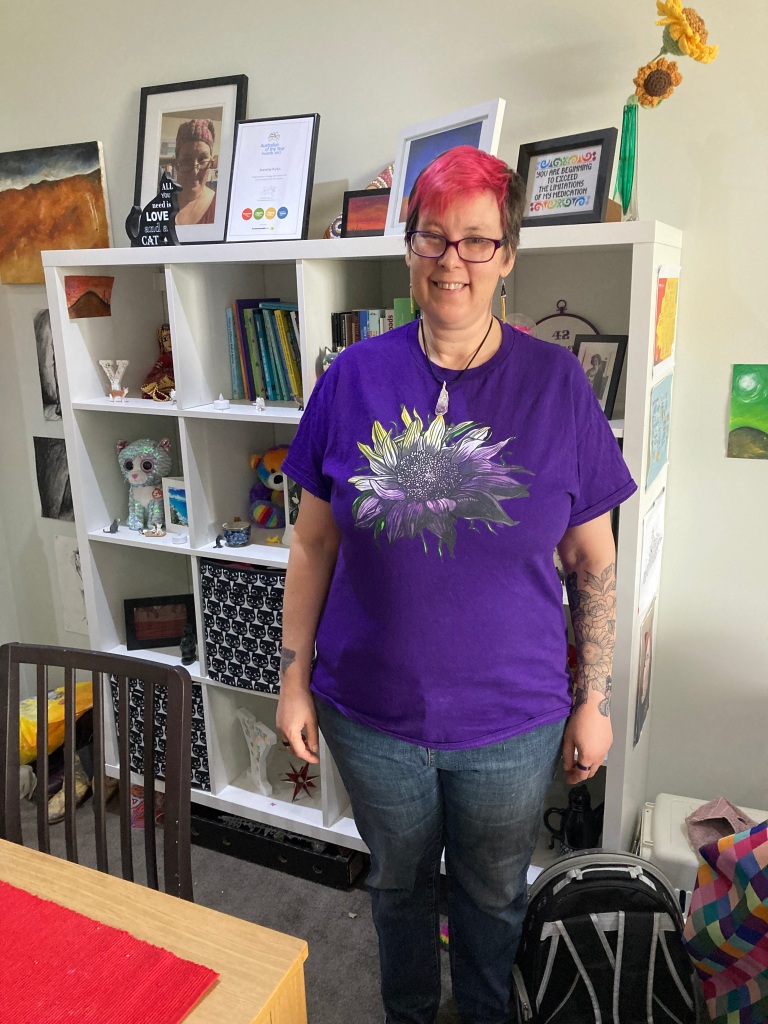
I had someone online tell me that they loved my ‘sweet enby style’ (for those who don’t know, enby means non-binary). The way I present to the world – my hair colour, tattoos, pride jewellery and t-shirts  etc- are a way of me demonstrating my pride as a autistic and non-binary person. The way we choose to express ourselves can be seen as very political. To my mind it shouldn’t but we live in a world where there is a lot of bigotry and ableism in the world. 

There is an assumption that autistic people are all asexual, cis gender, white men. Along with this is the stereotype that we don’t care about style or fashion and are all maths geniuses. I actually don’t know any autistic people who fit that stereotype! I have met a lot of autistic people who have a very strong sense of style and use their style to express who they are and their autistic identity. Others aren’t hugely interested in style and that is perfectly OK. We are all different. 

I do love to express myself through things like my clothing, jewellery, hairstyle and tattoos.  People tell me they would love to look like me and I say ‘oh but you can if you want to’ but I think that may be wrong. Being Yenn is a pretty individual thing, a bit like how I decorate my home. I suspect I am the only person who could express themselves like I do because there is only one of me – just like everyone else!

I think pride – be it Queer pride or Autistic pride – is a great thing and if we can express our pride through our expression that is a wonderful thing. My gender rand my autism should not need to be political but they are and if that s the case then expressing pride and positive self-knowledge through my style is a great thing to do. 

So be loud and proud and wear your rainbow wig I say! 

Yenn’s thoughts on the festive season

I do not celebrate Christmas. I am not religious and I don’t believe in Santa Claus! In Yenn hell I think it would be Christmas every day. I just went out to get some milk and the shops were so busy it was really overwhelming and unpleasant. While I recognise that Christmas is a happy time for many it is also a big problem for others.

Some of my issues relate to the waste of resources involved. There is an expectation of giving gifts and while I am all for giving, it often results in people spending money they can’t afford on gifts people don’t need or want. Yup, Yennski the grinch!! But in all seriousness the world is in trouble due to waste and overuse of resources. I think it would be nice to replace gift giving at Christmas with doing something positive for the environment instead. 

Kids are supposed to like Christmas. In fact when I was a kid I loved it. There were shiny and sparkly things everywhere and I was given toys and other gifts. We never had Santa Claus at our house because my mum is very Christian and presumably felt it was not in keeping with the Christian origins of the day – although we always had a Christmas tree and presents which weren’t really all that Christian! People are complicated.

As an adult I went through a number of stages of thoughts on Christmas. My early adult years were spent mostly in prison and psychiatric hospitals so Christmas was an institutional affair without any family present. I remember as a prisoner being given a special call with my parents on Christmas which was nice. When I got out of all the institutional care (and I use that word very lightly), I usually did Christmas with my family. It was very stressful – not because my family were horrible but because off all the expectations. 

In 2010 I got really unwell with mental health issues. I spent some time with family and it was really stressful due to my illness. I didn’t really want to ‘do’ Christmas any more. Shortly after hat I got a cat who was a wonderful excuse for not doing Christmas as I couldn’t get boarding for him over Christmas.

The first time I didn’t spend Christmas with family I spent it with a friend as I didn’t want to be alone. I was influenced but he expectation that you HAD to spend Christmas with family or you were somehow deficient or sad. Now I am absolutely happy to just spend it at home with kitty and nobody else. It really is just another day for me. I bought some very expensive and delicious  cheese and quince paste and some wine and will have a little holiday celebration with Sunflower the cat and that will be absolutely fine. I have not purchased or received any gifts apart from my Secret Santa at work who got Sunflower a cat tunnel and who I bought a mug with books on it.

And beyond me, autistic people can have positive or negative experiences of Christmas. Sensory things can either be very positive or very negative – or both! Giving and receiving gifts can be a source of delight or a source of stress. Seeing family can be wonderful or dreadful – or both depending on the family member! The religious element of the festival can be affirming or annoying and the commercial nature of the holiday can be engaging or fraught. You don’t have to celebrate if you don’t want to – or you can go all out and spend loads of time, effort and / or money to make an amazing Christmas If you celebrate please be aware that not everyone does, often due to cultural reasons but also people like me who just don’t want to do it. 

I hope you have an amazing festive season if you celebrate it.


Substance abuse and the autism spectrum 

The title of this blog post was the title of a book I was supposed to write in 2007 but didn’t. It would have been my second book but I asked the publisher to pull the contract due to me only having enough content for a chapter and not a book! However I have a lot of content in this space from a lived experience perspective rather than an academic one.

Between 1995 and 2004 I had a big problem with illicit drugs. I used mostly marijuana to self-medicate in a world which was confusing and frightening. Some people can do drugs their whole life without it affecting their mental health. Sadly I am not one of those people. In 1995 I smoked cannabis pretty much non-stop. This resulted in my first psychotic episode. I am still prone to psychosis over 25 years later which is not OK. At the time I was in complete denial about my sensitivity to mental ill health related to drug use. I also used amphetamines and LSD as well – not good for psychotic illnesses either!

It took me almost ten years and several hospital and prison stays to realise that drug use was largely the cause of my mental health issues. I am happy to say I have not used any illicit drugs since 2004 and I never will again. These days I am trying to avoid psychosis, not encourage it!

In 2003 I moved into public housing. This was a time where I had few friends and was desperate to be socially accepted. I had over 100 neighbours, most of whom were alcoholics or drug users. I made friends with the drinkers and so effectively became an alcoholic myself. I was at university at the time and lived a double life. I often went to university classes very hung over and cranky! I knew I was drinking too much but found myself at a different neighbour’s house each night drinking to excess. I didn’t want to drink so much but to be socially accepted by alcoholics it is pretty much a given that you need to drink heavily. While I was definitely a drug addict in every sense of the word I was not really an alcoholic. I drank excessively to be socially accepted. When I moved to Canberra to take up a professional role in 2007 I stopped drinking excessively. 

I know the stereotype of an autistic person is someone who follows all the rules and doesn’t get involved in drug use or alcoholism. In fact a lot of autistic people have issues with substance abuse for a number of reasons. For me the drug use was about numbing the trauma I had experienced as a child and young adult. For some it is about being socially accepted or being better able to socialise with neurotypical folks. What can happen for some autistic people is that when they are under the influence of drugs or alcohol they are better able to connect with neurotypical / allistic people who are also under the influence. Another reason is that emotions can be very confusing and uncertain. However when you are under the influence of drugs or alcohol you feel drunk or high which is a reliable feeling. When I used to smoke cannabis I knew what feeling stoned was like. It was a consistent feeling and there was no uncertainty. Some drugs and alcohol can help with anxiety as well and many autistic people have severe struggles with anxiety meaning it is tempting to take drugs or alcohol for a sense of certainty and to address anxiety.

Drugs and alcohol are not necessarily all dreadful. Many people use cannabis for pain and other medical conditions and find it helps a lot. Alcohol in moderation can be a lovely thing. I myself occasionally drink wine or my signature drink, a gin and tonic – and in moderation it is very pleasant. Situations where drugs and alcohol are a problem include if someone needs to have them constantly just to live their ordinary life, if it is getting in the way of work, parenting or relationships, if it affecting mental or physical health negatively or if someone is spending all their money on drugs and alcohol and may be stealing or committing fraud to support their habit. 

I can tell you it is possible to overcome drug and alcohol addiction because I did but it can be a difficult thing to do and can take a lot of time and effort. Accessing helpful support is essential in overcoming drug and alcohol addiction as is accepting that you have a problem and wanting to change. Autistic folks can have issues with drugs and alcohol just like anyone else does. It is not a reason for judgement or blame, more a reason for kindness and support. 

I love a good epiphany

This blog post comes courtesy of my mum – probably my favourite person in the world. I was talking to her on the phone which I do most days and she said ‘you should write a blog post about epiphanies.’ And I thought yes I should!

I always say that I love a good Yenn epiphany and I do. I have had some doozies over the years. I want to share some of them with you because I think they are lovely and maybe they will inspire you to have an epiphany as well! The first one that I remember was in 1999 when I was 25 years old and a very broken and desperate prisoner. I know a lot of people don’t think it is possible for me to have been a prisoner but I was, on several occasions between 1994 and 2000. The epiphany I have in 1999, just as the millennium was about to happen was ‘new millennium new life.’ I thought that I could change my life and I did. A month later I left prison for the past time and started on my journey to the amazing place that I am in now.

The next epiphany I had was in 2001. I was living in accommodation for young people with mental health issues. The house was a crumbling mansion in Albert Park – one of the most salubrious suburbs in Melbourne. I would see these women walking their kids in the park during the day. They were not unemployed and poor, their partners had such a good job that they could afford to pay a million dollar mortgage on one income.  I saw these women and thought I wanted to be ’ordinary.’ I didn’t want to get in a relationship with a rich man and walk my baby in the park but I wanted an education, a ‘real’ job, a mortgage and a suit. I was determined and within eight years I had all those things. In fact I have had TWO mortgages at the time of writing this as I sold Whimsy Manor in 2020 and bought Yennski Central last year,. ‘Ordinary’ was s a lovely epiphany which yielded a new life and an escape from poverty.

I also had an epiphany recently which was around taking responsibility for my life and knowing that I am in charge. I make the decisions who drive my life. I have had any number of mental health-related epiphanies over the years. My advocacy career is based on an epiphany as well. In 2012 I was in the psychiatric ward and met an autistic young man. When I told him that I had written a book and worked in the public service and that I was autistic he told me I was lying because that was impossible. This young man had been told so many negative things about being autistic and fed a bunch o deficits thinking that he genuine believed my life was impossible. I realised that I needed to make the world a better place for autistic folks and that if there was one person like that then there must be more. This sparked my current passionate interest for autistic advocacy. Since then I have given countless talks including two TEDx talks and written a further 16 books and become quite well-known as an advocate!

So epiphanies can be a really good thing. They have definitely changed my life. The other things that tie in with my epiphanies are determination, motivation and inspiration. I have all of these things in spades. The epiphanies alone probably wouldn’t make much difference without the determination, motivation and inspiration to deliver them. I know that I am unusual in this space. I have made immense changes in my life and gone from being the most desperate and miserable prisoner to being a community leader and all round awesome human being (if I do say it myself!). I love my epiphanies and the qualities which enable me to put in place the changes. So yes, have a good epiphany, change your life, change the world! 

The problem with “phases” 

Very few things in life are permanent. There are exceptions which I demonstrated yesterday by getting a tattoo – quite a permanent sort of thing and something requiring consideration and thought. And, in case you are interested I got flowers (peonies – because I like them – and sunflowers – because I like them too plus my cat’s name is Sunflower so I have spent the ten months that I have had her collecting sunflower things!) The design also has two blue and pink butterflies – blue and pink are the transgender pride flag colours. The butterflies have semi colons for bodies. This is very significant, quite profound and rather beautiful. If you imagine you are an author (not very hard for me to do!) and your life is the book you are writing. You could choose to end the book with a full stop or put in a semicolon and keep going. Given that the main reason for the design was to hide scars form self-harm in the 1990s I think the semi colon is a good thing! Anyway it was very painful, took six hours and the end result is amazing and now I want another one!… 

But Yennski’s new ink was not the main reason for this post. The reason for this post is to reflect on the impermanence of most things in life and to reflect on why it is not OK to have loaded language around impermanence. By this I mean the way whenever a young person – and particularly an autistic or otherwise neurodivergent young person – comes out as being of marginalised sexuality and / or gender they seem to face a barrage of ‘oh you are just confused’ or ‘you are going through a phase…’ Firstly it is actually OK to change your mind about your gender or sexuality. Many people do. I have. I identified as lesbian for many years and am now identifying as Asexual (‘Ace’) This does not render the time I spent as a lesbian as invalid. I guess it WAS a phase but so what? Also one of the main reasons people detransition (i.e. go back to the gender they were assigned at birth after affirming a different gender) is that they face bigotry, often from the same people who say transgender people are going to change their mind as use this to criticise transgender folks! The first time I discovered that statistic was a bit of an eye-opener for me to say the least! 

I want to look at phases though. Imagine if you came to me and said ‘oh Yenn I got a new job!’ And I responded with ‘Lovely. But you know it is just a phase’. Or if you introduced your new partner to me and I said ‘That’s fantastic but it’s just a phase!’ You would understandably be horrified, but employment and relationships are almost always a phase. I only know one person who has had just one partner in their life and one person who has had the same job. So what do we not confront people with new jobs or new partners with the whole ‘it’s just a phase’ thing?

Phases are very loaded indeed. To dismiss someone’s sexuality or gender identity by saying it is ‘just a phase’ is actually a major case of invalidation. Invalidation is where you treat someone like they or their experiences or attitudes don’t matter.  It happens to autistic folks A LOT. And in fact, even if someone changes their mind or actually is confused by their gender identity or sexuality, don’t dismiss and invalidated them, support them. 

So my tattoo is not a phase. I have it for the rest of my life – so it is a good thing it is beautiful and meaningful. Lots of things in my life aren’t permanent and that is OK. Please don’t invalidate autistic and LGBTQIA+ young folks with these attitudes. And in my experience the ‘phase’ argument is almost exclusively used with young people of marginalised sexuality or gender so it is actually transphobic / homophobic / biphobic and ableist and as such not OK at Yennski Central!