‘Oh, but you don’t look disabled…’

This statement is something which often gets called a microaggression. Something most likely unintentionally offensive but offensive, nonetheless. It is one many of us who belong to different ‘inclusion’-type groups come up against. There are a number of other variants – ‘you don’t LOOK autistic’ or my personal favourite ‘You shouldn’t say you are autistic – you could pass for normal’ (and someone did actually say this to me once! And worse still they said it at the launch event for one of my neuro-affirming and inclusive books written by a proud autistic person who doesn’t even know what normal is, let alone wanting to look like it!)

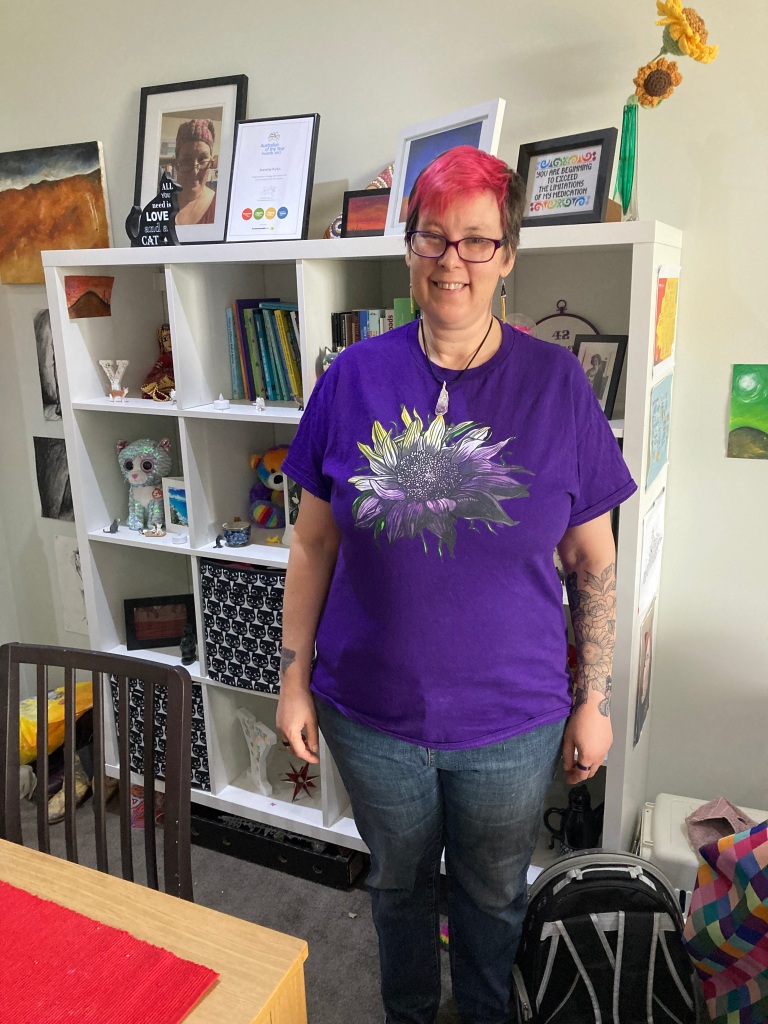
I have recently been diagnosed with osteoarthritis in my left knee. It is really painful most of the time and standing for long periods – such as on public transport – can cause a lot of misery in the Yenniverse. As such, sitting in the accessible seat it’s the best option but I don’t ‘look’ disabled, and I don’t ‘look’ old meaning I can cop a lot of judgement from well-meaning people. I have tried to address this by using a cane, but it is an ongoing issue.

Often the people doing this ableism have no idea they are being ableist and unhelpful. They think they are doing the right thing – making it almost impossible to take up the issue with them and get through to them!

The most glaring example of this – and sadly a very common issue – is accessible parking spots. People get shamed for using accessible parking spots by people who think they ‘don’t look disabled enough’ to use the space. Basically, if there is a sticker on the windscreen saying the person needs accessible parking then go by this, not some assumption that Disabled people who drive should have to have a wheelchair in order to qualify for the accessible parking spot! If the person has a sticker, then they are eligible for the access. Simple as that. Mobility issues do not just mean those that result in person needing to use a wheelchair or cane. Some people have fatigue issues meaning they can walk a bit but walking across the entire IKEA parking lot (or whichever business) would cause serious distress. Being the accessible parking spot ‘are you disabled enough?’ police does not help anyone and actually does more harm than good to Disabled folks.

A lot of the issues in this area relate to unhelpful assumptions. I will categorically say that you can’t tell someone’s disability by looking at them. Disabilities come in all sorts of different shapes and sizes. It is not helpful judging people based on assumptions in any area. These issues are to my mind in the top 5 of ableism issues. They are absolutely infuriating. And I shouldn’t have to use a cane in an attempt to convey my need for accessibility requirements. Nobody should have to justify their health conditions to a stranger on the bus! We really would be better off in a world where people didn’t assume and didn’t take it on themselves to be the accessibility spot police.

Basically:

  • There is no disabled ‘look’
  • There is no autistic ‘look’
  • You can’t determine whether a person needs an accessible spot or other accommodation just by looking at them
  • ‘Normal’ is not something people should aspire to – and probably doesn’t exist anyway.

And don’t get me started on disability and ‘inspiration’… although I think the is a whole other blog post!

Autistic burnout

Content warning – mental health issues

Autistic people tend to be more susceptible to overload and burnout than others. There are reasons for this which I will include here, along with some helpful strategies.

An autistic friend once told me that despite being very busy and managing a huge workload I probably didn’t experience burnout because I never mask. With Yenn what you see is what you get – and if neurotypical people have an issue with that I genuinely don’t care! I hadn’t thought of this, but it did make sense. Masking takes a lot of energy and when put in the context of other stressors can tip people into burnout. Burnout to my mind at least, happens when the amount of mental energy you are putting out in order to manage life is significantly more than the amount you are taking in. Burnout is often related to doing too much and it often relates to many separate things – meaning it can be difficult to identify what is causing burnout.

Burnout is basically a response to overload and overwhelm – too much of socialising and relationships, too much sensory input, too much work, too much concern around managing daily life (finances, going to the shops etc). Autistic parents also often experience burnout around raising kids. It can sometimes be hard to pinpoint what thing or things have triggered burnout give the many elements of our lives and the things which take a lot of energy.

The ‘fix’ for burnout involves either avoiding it in the first place or managing it once is has occurred. The strategies if you actually end up in burnout usually revolve around stopping doing the things that contributed to the overload – and often other activities too. while it is often not possible to stop doing EVERYTHING it really helps to excise the stressors causing the burnout if you can identify what this or these are. When I was a lot younger, I experienced overload based mostly on anxiety around a job I had. I got so overwhelmed that it triggered my schizophrenia and I ended up in hospital. The first thing I did was s quit the job I had – this did not make me instantly better, but it avoided further exacerbating the overload. It took me over a year to get back to my usually happy Yennski self. Burnout is a big deal!

A preferable approach to managing burnout is to avoid it happening in the first place. If you feel high levels of stress when doing something and you dread doing it than it might be bast to stop doing it if you can. We tend to struggle with this as humans and as autistic humans. We feel we HAVE TO keep doing something even if it is destroying us. Another Yenn employment example… In one of my recent jobs I was really struggling. I was so overwhelmed and stressed that I spent a lot of time on leave and found myself wanting to die. I figured that no job was worth losing my life for. I got out of there and managed to (just) avoid what I am imagine would have been a significant period of burnout. I was able to do this based on my memory of burnout in the past. I also knew that my workplace would survive if I left, nobody would die, and everything would actually be OK.

Many people think they can push through stress and overload and put off making any changes. They may worry about being judged if they cancel of postpone something. When a major stressor is employment it can be really difficult for people to leave given that it is their income. However,  by not responding to impending burnout they may have to take even more time and avoid doing things for a longer period.

A lot of autistic people have something called alexithymia, also known as emotion blindness. It does not mean that a person lacks emotion – far from it! What it means is that a person struggles to articulate their emotions. It can mean that high levels of stress and overload can go unnoticed, often leading to burnout. It can help to listen to friends and family members if they are concerned about you getting burned out. Others may notice things about how you are presenting to the world and if you seem to be  overloaded, overwhelmed or highly stressed.

There are some things you can do to support your mental health and energy levels and avoid burnout:

  • Try to be aware what experiences are causing you high stress and reduce or stop doing those if possible
  • If you go into burnout then you may need to stop doing all but essential things
  • Be aware that it is not the end of the world to not do something or postpone something
  • Take time to do things which make you feel relaxed
  • In terms of burnout, prevention is better than cure – i.e. it is much easier and less traumatic to avoid getting burned out in the first place
  • Seek support for stress, e.g. from a competent psychologist or psychiatrist
  • Remind yourself that your mental health is critical. If you have to postpone something or stop doing something it is not the end of the world.
  • Remind yourself that with support and care burnout will pass – it tends to be a transient experience
  • Strategies can include spending time attending to your needs as an autistic person – such as stimming, spending time on a passionate interest and spending time with autistic peers
  • Sleep and take rest where you can
  • Create a sensory friendly space for yourself / stim
  • Spend time with people that understand you
  • Assertiveness and setting boundaries around your workload and social communication are also important
  • Reduce your workload and / or social load 
  • If thinking about doing a task or activity fills you with high anxiety stop doing it (providing it is something you can avoid doing). If you can’t stop doing something then seek support in order to do it
  • Be aware that many people experience burnout. It is not a failing or flaw and it doesn’t make you less competent as a human being. Try not to apologise or blame yourself 
  • Give yourself time. Burnout can take a while to resolve
  • Burnout is not something which goes away – autistic and neurodivergent people are susceptible to burnout their whole life. It is a matter of identifying when it is a risk and supporting yourself to avoid it taking hold.
  • Where possible, avoid doing the things which contributed to your burnout in the past.

Being able to manage these things can make a big difference.

Reframing Autism has some helpful information around burnout as well – Autistic burnout

Kindness

I used to be poor. I lived in public housing and my income mostly came from Centrelink. I had very little choice in things like where I lived or what I spent my time doing. I received Centrelink benefits from 1995 – 2007, mostly the disability pension. I could not work despite wanting to. My anxiety around employment was significant. My life then was very different to my life now. These days I have good savings, have a mortgage on my apartment and earn my cash from being self-employed. My attitudes are very different, I am much more confident. I used to work in the public service. I went straight from disability pension to public service. My income quadrupled! It was wonderful.

I don’t really want to talk about poverty though – although it’s probably a topic which needs to be explored so I will add it to my blogs to write list. What I want to talk about today is kindness. The often quite small things people can do to make a difference. One very unhelpful stereotype around autism is that we are all arrogant, thoughtless people that don’t care about anyone other than ourselves. This is a really crappy stereotype and not in the interests of me or my neurodivergent peers, friends and colleagues, and it is also a very long way from the truth. Autistic people tend to be very thoughtful of others and very kind. We might express it differently sometimes but we – adults and kids alike – tend to want a kinder world for those we love and care for.

Anyway, in my own life I have experienced a lot of kindness, and especially when I was poor. People say you shouldn’t give poor people money although I am not 100 per cent sure why this is. When I was poor, I had two people give me what to me was a lot of money and it was a lovely and very helpful thing. The first was my dad. Out of the blue he sent me and my brother a cheque for $1000 each. It was so nice and actually made a big difference in my life at the time. The other one was one of my former socialist comrades. In 1993 there was so a protest in Melbourne and the police were, might I say a little overenthusiastic in the use of their batons! Lots of us got injured and some of the protesters successfully took the police to court. I was not part of the case due to various circumstances (I was in prison – long story – chapters 6-8 of my autobiography if you want more info!!). Sometime later I saw my former comrade at a socialist book stall, and she gave me a cheque for $1000 as well, part of the payout from the court case which my comrade thought I was entitled to even if I wasn’t part of the court case.

I have had people demonstrate so much care and kindness to me over the years. I have a lovely friend who was my main support when I was unwell with my mental illness in 2019-2021. Because COVID and lockdowns were happening the hospital staff questioned my friend for visiting as you could only have one visit a day so it should be your partner or family. My friend took to saying she was my sister – and a very supportive and loving sister she was! And don’t worry, my family were not being slack in not visiting me – they were interstate, and I definitely got some visits form them too just not all the time!

Kindness is sometimes very easy to do, and the impact can significantly outweigh the effort the kindness took. I want to make sure I am kind and that my actions and statements help people and empower others to feel supported, included and respected. I actually struggle with people not being kind. To my mind there are people who are meet someone vulnerable and look for ways to exploit or abuse them and then there are those who want to help. I don’t actually understand the first of those attitudes. My aim is to leave the world a little better when I depart  than it was when I came in.

Kindness and thoughtfulness can make such a difference. I am grateful to everyone who has shown and continues to show me kindness. So put some good in the world and rock the kindness casbah!!!

The Wonderful World of Work – sort of…

In 2013 I wrote what would become my second Yennski book. It is a book for autistic teens to support their entry into the workforce. The book is called The Wonderful World of Work. The funniest thing about this book was the feedback I received. The day it came out someone posted a review basically saying the world of work for autistic people is anything but wonderful. This was the first feedback I received, and it got me a little concerned! I wondered if maybe I should have called it something different? Perhaps ‘The OK, challenging and sometimes fraught world of work’? Not sure. The good thing was that everyone else seemed to love my positive and encouraging take on employment and autism.

Work is a pretty important part of life for lots of people. Autistic people face discrimination and exclusion at work. The statistics are worrying to say the least. The unemployment rate for autistics is significantly higher than that for neurotypical people and also higher that for people with disability more generally (using the term ‘disability’  reflecting the human rights and social models of disability rather than the medical and deficits-based view). Autistic people face discrimination in recruitment with things like interviews and CVs required for most roles.   These processes do not favour autistic applicants. There are alternatives available such as work trial activities instead of interviews, but these are rarely used despite being effective for neurotypical applicants as well as their neurodivergent colleagues.

Anxiety is a big issue at work. I spent many years unable to work due to high anxiety and perfectionism. I would have dearly loved a job, but at that time it was impossible. I had to put in place a range of strategies and incrementally more challenging steps to get to the point that I could work full time. I ended up in the public service and stayed there for just over 17 years. I mostly enjoyed being a public servant, but it was full of unwritten rules and my colleagues and managers tended to be very different to me! I was one of a very small number of people in my office with vibrantly coloured hair! And I always figured if I was wearing something to the office it was office attire! Mostly my managers and colleagues were OK with my quirkiness but there was always a clear difference between me and my colleagues – how I presented, identified, thought and approached the work.

I left the public service earlier this year to become Yennski the business! Absolutely amazing, liberating and completely terrifying! I do really love being my own boss. I work at home and get to spend time with my kitty which is amazing, plus my work is now exclusively related to neurodiversity and Queer advocacy – which are my passionate interest. So basically, I get paid for doing something I absolutely love. Just wonderful – and I wish I had done it ages ago. Being a business results in some things I hadn’t anticipated. The first is my attitude to money and income. I am now very careful with my money and don’t generally buy things I don’t need. When I was a public servant I didn’t think twice about spending money but now I am hyper careful. The other thing is uncertainty and patience. I spend a lot of time waiting to be paid and waiting for responses to pitches for work. I am NOT a patient person, so this is an ongoing challenge. I have to tell myself not to bother the people I am working for! Mostly I am loving being self-employed – and Sunflower kitty loves having me home. Thankfully thus far I am earning enough money to pay the mortgage and other essentials (like cat food and books!) I have a big spreadsheet tracking my income and expenditure – gotta love Excel. I juts had a very long conversation with someone signing people up for Save the Children. I am way too frugal to take on new charity donations and he was very persistent! Thankfully I could do assertive at an Olympic level these days so I managed to escape without committing myself to lots of expenditure I can’t afford!

One thing which really bothers me is when autistic advocates and spokespeople who come from privileged backgrounds and assume anyone who is unemployed – including their autistic peers –  is not trying hard enough. One commentator famously said that autistic people who are unemployed should ‘get off their butts and get a job.’ I was on a panel a while back and one of the panellists – a straight, white, cis gender, heterosexual, middle class man (who had pretty much all the elements of privilege in exception to his being autistic)  – said that autistic people who are unemployed were being ‘lazy.’ As an autistic person who spent twelve years desperate to work but being unable to due to anxiety and mental health issues (among other things) I find these sorts of statements highly offensive and unhelpful. More often than not, unemployed people – autistic or otherwise – want to be employed and if they are not then there is a genuine reason for this – not them being ‘lazy.’ I feel privileged that I got to work in government administration for 17 years and I feel privileged that I can be a business and get paid for doing things I love.

It is important to also note that not working is not a failing. Some people can work, some can work sometimes but not always and some cannot work at all due to a range of reasons. There should be no judgement around whether or not a person can work. Employment is not a measure of a person’s worth or character.

My world of work at the moment is pretty wonderful. I wish a wonderful world pf work to everyone who wants one. I think the workplace generally could benefit from some more understanding and respect of neurodivergent people. Things have been changing in this space recently, but I think they need to change more to ensure those who are able to work find a suitable job. And within those jobs that they are supported through inclusive recruitment processes and are accepted and respected in the workplace. There is a wealth of evidence around the benefits of companies hiring neurodivergent staff so employers can definitely benefit from having us in the workplace too – and we can hopefully benefit from being there too. I really do want everyone to have a wonderful world of work – whatever that may mean for them.

Happy Neurodivergent Pride Day

Today, 18 June, is neurodivergent pride day. Big yay to that! So, what do neurodivergent people have to be proud about? Well actually quite a lot. I can’t speak for anyone else but pride for me is about survival, respect and sharing my perspectives with a world that doesn’t always appreciate or understand them. I am a very proud autistic and ADHD (also known as AuDHD) person. However, this was not always the case.

I was diagnosed as Autistic in 1994 when I was twenty. The other thing to know about twenty-something Yennski is that they were a prisoner with some pretty significant drug issues and a very negative attitude. They masked and camouflaged in order to survive as an autistic prisoner. When my younger self received their autism diagnosis, they really didn’t like it – or accept that it was correct. Surely they were a big tough criminal? Yup, I was so good at masking that I even convinced myself. Pride was a long way off!

It took me seven years to accept my autism and a further eight years to properly embrace it as a core part of who I am. For a long time I was more comfortable telling people I had been in prison than I was to tell them I was autistic!

Thankfully there were some lovely positive influencers in my journey who helped me to come to a place of pride. The main one was my former autistic mentor Polly Samuel (who is sadly no longer with us). Polly supported me to write my first book – this we s a huge step on my road to acceptance and pride.  My parents were also really helpful. So now I am extremely out loud and proud as an AuDHD person, author, advocate, consultant and influencer – and human servant to my feline overlord, Sunflower the naughty tortie!

We all carry our own history and journey to pride. While the expectation seems to be that autistic people getting a diagnosis immediately embrace it and have a sense of pride this is not always the case, and that is actually OK. My own story demonstrates this. We all walk our own path.

I am now extremely proud to be me and embrace and celebrate my neurodivergences. I am proud of a number of things about my neurodivergent self. These include:

  • Determination
  • Empathy
  • My various ‘gifts’ and twice exceptional skills
  • My love for nature – and cats!!
  • My work as an advocate
  • My wonderful Yennski books – all 18 of them!
  • My neurodivergent peers and friends
  • My creativity
  • The fact that I have overcome immense barriers to get to where I am
  • My various Queer identities

So, to all my neurodivergent friends and compatriots I say get your pride on! Of course, every day is neurodivergent pride day in my house – and it should be everywhere. But having a specific day is a great way of highlighting our reality and the great insight, value, power and strength we so frequently bring to the world – Or just the fact that we exist as neurodivergent people and all that migt entail  So go forth, be proud, change the world and be your own wonderful and amazing you.

And this image is a historic Yeme so says Autistic pride day – I don’t have an updated one for neurodiversity pride day but you get the picture!!

Thoughts on object permanence and autism

I had the absolute privilege to MC a presentation by autistic advocate and author, my friend and co-author, the wonderful Dr Wenn Lawson today. I always love seeing Wenn present as he is a fantastic speaker and has a wealth of knowledge in a number of areas. One of Wenn’s areas of interest and significant expertise is the concept of object permanence.

What is this you may ask? I asked Google which provided this explanation: Object permanence means that you know an object or person still exists even when they are hidden and you can’t see or hear them.

Clinicians used to think (and many unfortunately still think) that autistic people lack empathy meaning we can’t understand what others are experiencing.

The idea of autistic people not lacking empathy per se but instead having difficulties around object permanence is a view which has more recently been adopted and to my mind offers a more accurate – and more inclusive – view. This suggests that autistic people are not aware that someone or something exists if we cannot ‘see’ them. Some people worry that their family and friends don’t exist until they are actually standing in front of them. My own experience of this is that if someone is late that I think they won’t turn up and I will be waiting forever. And I think if someone doesn’t respond to an email or message that they are never going to do so. Mixed in with my impostor syndrome and rejection sensitive dysphoria and you can probably imagine the resultant stress. In fact, I am stressed about this right now!

I will explain… I am working with an organisation that I haven’t been working with for long. I had to amend a document and send it back. The manager has not responded yet. Logic tells me she is probably busy or doing something else. Despite logic, I still called her and she didn’t pick up the phone – this catapulted me into thinking I had somehow offended her! This is an object permanence issue. Without reassurance, I assume that the employer will stop working with me and all sorts of other dire things because I cannot hold that event or relationships in my mind. I assume the opportunity will just disappear. I call myself the follow up fairy because I am a shocker for following things up for this very reason.

The anxiety caused by object permanence issues can actually damage your career and relationships. Many years ago I was invited to give a keynote alongside Temple Grandin and Tim and Judy Sharp. This was early in my advocacy career and I was absolutely delighted and very excited about this opportunity. However, I could not ‘see’ the event so I needed reassurance from the organisation hosting the talk. I would have called them at least once every week often more than that! I wasn’t asked to do the presentation the next time it was held and I am sure my stressy-ness about it probably contributed to that decision by the host.

And I do need to talk about empathy here because understanding around these things is closely related. Autistic people have all sorts of different experiences of empathy. Some people have very heightened empathy and can pick up on the feelings of people around them as is by osmosis. Some autistic people are highly thoughtful and kind. And then some have low empathy. Often we have ‘better’ empathy for other autistic people and less for our neurotypical peers. This does not mean we lack empathy – far from it. In fact neurotypical people tend to have less empathy for autistic folks than they do for their fellow neurotypicals.  Autistic academic Dr Damian Milton has written and presented widely on this through the concept of the double empathy problem.

I find my object permeance issues quite frustrating and wish I could just relax for a little bit and know that the most likely reason is usually the correct one and just because I can’t keep it in my mind does not mean it doesn’t exist or isn’t going to happen. For example conference organisers are almost certainly not going to change their minds and cancel my talk on a whim but I am always worrying about this because I cannot ‘see’ the event or my participation in it!  Even if I can’t see it, I don’t really need to constantly reassure myself that everything is OK, my work still exists and people are still there even if they do not remind me of that all the time.  

I think we need more understanding of object permanence as it explains a lot about the experience or many autistic people.

And here is a link to Dr Wenn Lawson’s website: https://www.buildsomethingpositive.com/wenn/ and Wenn’s YouTube site: https://www.youtube.com/channel/UCD8L-Ht_jSQxBmWe6MzZvJA  

My thoughts on rejection sensitive dysphoria and also why I am finally embracing my ADHD  

I recently came across a new term – Rejection Sensitive Dysphoria. What is this you might ask? Well, a quick Google tells me that: Rejection sensitive dysphoria (RSD) is when you experience severe emotional pain because of a failure or feeling rejected. This condition is linked to ADHD and experts suspect it happens due to differences in brain structure. Those differences mean your brain can’t regulate rejection-related emotions and behaviors, making them much more intense. 

I actually think it isn’t just ADHDers who experience this. I think a fair number of autistic people – and others – probably do too.  

The description of RSD sounds so like me you wouldn’t believe it! I am terrified of criticism and feedback. Receiving constructive criticism is one of my absolute least favourite things! It makes me stressed, catastrophise and makes my self-esteem take a nose-dive. I don’t even like waiting for what I am fairly certain will be positive feedback! And making errors and mistakes fills me with dread. While part of my message as an author and advocate is for people to make positives out of failure and setbacks, I am not always following my own advice. It makes professional employment very challenging – and was a large contributing factor to me recently leaving my previous job.  

A lot of people don’t understand this condition. They see it as a character flaw or something which can be changed through willpower alone. However, I know that I cannot change this part of being me just by applying some positive thinking – if I could I most definitely would as rejection sensitive dysphoria is very unpleasant and potentially very limiting. 

However, if it is a part of ADHD, it can probably be viewed as primarily a negative one. I can’t speak for anyone else, but I actually quite like my ADHD as it involves lots of really nifty attributes which make it possible for me to do the things I do. 

The positive qualities I experience are… 

  • Enthusiasm and optimism 
  • Humor 
  • Creativity 
  • Unconventional thinking style 
  • Hyper focus  
  • Imagination  
  • Excitement    
  • ENERGY!!!!! 

These qualities are just lovely. And the best one is the affinity I feel for (most of) my fellow AuDHDers. AuDHD is I guess another neurotype – and quite a common one, I think. I keep meeting more AuDHDers (and if you have not; come across the term is means a person who is Autistic and ADHD. There are lots of us!) 

While I do rather like my ADHD, I don’t think I understand it the way I do my autism – I’m looking forward to a journey of discovery in that space. It is hard to separate out the elements of my ‘me’ that are ADHD and which are my Autism. I am both things. I suspect it isn’t really possible to reliably separate them out. This is because AuDHD is probably not autism + ADHD rather it is a complex combination of the two neurotypes. In fact, I think it is probably a completely different neurotype – something which is ‘more than the sum of its parts.’ I have heard other people talk about the idea of an AUDHD neurotype too.  

Many adults struggle to obtain an ADHD diagnosis. There are a lot of pervasive stereotypes around ADHD such as it is only for children / boys, that ADHDers are ‘rude’ and enfage in crime and anti-social behaviour and that the diagnosis is just an excuse for poor behaviour. I think the understanding of ADHD in adults is at a similar stage to where understanding around autism in adults was ten years ago. I think a lot of adults in the coming months and years will seek an assessment for ADHD and there will be more knowledge on the topic in both the medical world and also in wider society.  

I look forward to learning more about this both from my own experience but also others’ – and maybe there will be some research literature in this area soon as well?  

I will share this with you… 

I have been talking about autism and employment for over ten years now. Whenever I present the topic to employers, I tell them that autistic staff members are often amazing at attention to detail. While this may well be true, it is NOT true for me! My attention to detail is horrible. I am a big picture thinker and miss errors – especially typos – all the time! This – as I have learned – is more an ADHD quality. Oh, how I wish I had the typically ‘autistic’ approach to detail not the ADHD one! Despite that I forgive my ADHD – it didn’t mean it! (And I will doubtlessly miss a large number of typos in this post!).  

…And now I will go post this blog, have some dinner, cuddle Kitty and then probably do three hours of work then go to bed! Yup, the self-employed and hyper focus thing is going nicely 🙂

New adventures – doing things you love.

Yesterday I left my job after 17 years. This was A Big Deal and the result of a variety of things.

Despite wandering around the house the day that I gave my notice saying to myself ‘hah ha you’re unemployed!!’ I do have some sources of income. I am now – after 17 years – basically a professional autistic, ADHD, non-binary and Asexual advocate. I will be doing consultancy, coaching, writing and presenting as a job. My income will be derived from doing something I love. How absolutely wonderful. I am very excited – and a little anxious from time to time. I will wake up on Monday and not go to work. Wow!  (Well given how vague I am I will probably wake up on Monday and get dressed for work, walk out the door and remember just as I am getting on the tram!!)

I have five employers lined up so imagine I may actually get more work than I can manage! However, I have essentially been doing two full time jobs for almost 20 years so I think I should be OK.

My new life adventure gets me thinking about other people’s employment journeys.  The wonderful Barb Cook and I wrote a book called Planning your career through intense interests a couple of years ago. It is aimed at autistic young people and looks at using your passion to drive a career. The ability to pursue your passionate interests as your job is a lovely thing indeed. Goal setting and career planning strategies can help and identifying what skills and interests you have.

I wish everyone career success and the ability to use their paid work to pursue their passions. I am excited at my own career adventure. A job should be enjoyable and engaging. It should help people build their knowledge, skills and wisdom. It should support development and engagement and self-esteem.  People – including autistic people – should have the opportunity for career advancement if they want it and are capable. There is a pervasive view among some managers that they have done an autistic employee a favour by employing them and they should stay at entry level and be grateful for it. This simply isn’t true. As a public servant I was promoted twice in my career because I was capable of working at a higher level. Work should be inclusive and free from bigotry and hate and bullying.  Being in the workplace should provide a sense of being part of something bigger, of making the world a better place as well as the more practical things like providing an income.

Autistic people can have a range of challenges in the workplace – often due to a lack of understanding from managers and colleagues. I had a boss once who when I raised my concerns about her ability to manage me as an autistic person said ‘Oh I know all about it. I managed an autistic person once’. These sorts of attitudes are sadly quite common. However, the workplace does not need to be an unpleasant place for autistic folks. We tend to have some impressive skills which set us apart from our allistic and neurotypical peers. I have worked in areas where I was highly prized due to some of the attributes which were related to my autism. I have been talking about autism and employment and the benefits of neurodivergent staff to employers for over ten years and it is a great thing to open their minds to the significant benefits of employing autistic staff. In fact, one of the things I will be doping in my new career is working with employers to support them to employ neurodivergent staff. Lovely!

People should want to be at work and should ideally look forward to going in to work. Of course, this often isn’t the case, but it can happen, and should be supported. Some of the best jobs I have had have been wonderful not due to the work itself but due to the managers. I once had a neurodivergent manager who was amazing. I had another manager who I loved dearly and am still in touch with after she retired many years ago. A good manager – or a bad one – can make all the difference at work.

I am happy to have had a 17-year career in the public service and I look forward to what the future may bring. When I was 25 – half my age now – I changed my life dramatically. Now I am doing it again. Scary and exciting. We will see how things go.

Oh, and as I am no longer a public servant, I can say this… I have politics! I vote Green! I really do and I always have. And I have an immense dislike of Pauline Hanson and Donald Trump and hope they both go to jail for a long time, and I think the world needs to fundamentally adjust its approach or we will all suffer major effects of climate change!! Ah, that felt good after 17 years!

Yenn at work

Twenty years – my journey to ‘ordinary’ (and beyond)

I was at a book launch last week – not one of mine but one for my friends Graeme Simsion (or the ‘Rosie Project’ fame) and his wife Anne Buist – also a wonderful author. They were launching their latest book, the best-selling The Glass House, set in a psychiatric ward and the protagonist of which is a registrar psychiatrist. I did a sensitivity read for the book – and can strongly recommend it by the way! My friend, neurodivergent advocate, co-author and all-round legend Barb Cook was there too, and we went out for dinner after the launch. While we were having a very tasty dinner complete with some very decent wine, I reflected that twenty years ago if you had told me I would be having dinner at a wine bar in Canberra with a group of three fellow authors I would have been, well quite surprised.

Twenty years ago was 2004. I was not an author; I did not live in Canberra, and I certainly didn’t have dinner with bestselling authors at a wine bar and to be able to navigate a menu at such a place. In 2004 I was living in public housing, I had a stalker among my neighbours and most of my socialising involved getting utterly trashed with my alcoholic neighbours. I wasn’t really an alcoholic myself in the usual way but I was desperate to be accepted socially and my neighbours were alcoholics so in order to fit in I drank excessively – impressively excessively! It was a difficult time. I was coming out of many years of criminal behaviour and drug use, and my life was something of a challenge.

However, I was also aspirational. I had ruined my life ten years previously by getting involved with a criminal and ended up in jail. It turns out to be very easy to wreck your life but a lot harder to get it back on track. In 2001 I decide dot make for myself an ‘ordinary’ life (such as having a job and a mortgage)  and by 2004 I found myself in two worlds – the criminal / druggie / alcoholic world inhabited by my neighbours and my past self and the very different world of university and aspiring to get a career and move out of the ‘ghetto’. In 2004 I was in my honour’s degree of a Fine Arts course. I was getting some renown in the Melbourne art world. I had some memorable experiences where I invited my alcoholic neighbours to high-end galleries for openings of my exhibitions.

I knew what I wanted: I wanted my life to magically transform into one where I was financially independent and where I was respected and could wear nice clothes. The odd thing was that this was actually just around the corner. In 2004 I was asked to participate in a training course with 20 other autistic people to be able to deliver talks about autism to school students. Mark Haddon’s novel The Curious Incident of the Dog in the Night-time (the central character of which is an autistic boy) was on the Year 12 book list at the time. The local autism employment service saw an opportunity to find  employment for its clients in giving talks in relation to the book. I went to the course and was amazed. I had never been around groups pf autistic people before. It was just wonderful and I felt at home. One of the other participants was an autism world celebrity, autistic advocate and author Polly Samuel, author of many books including the bestselling Nobody Nowhere. I was instantly entranced by Polly and her books. We became friends and soon I had the best mentor and aspirational autistic person could ever have.

Polly said I should write my life story. People had said this in the past and I always thought no way. I really didn’t need a bunch of people judging me for my dodgy past life and poor choices. However, Polly convinced me by saying that if I wrote my life story it would be for the parents of autistic young people who get caught up in the criminal justice system and who feel ashamed to engage with the other parents. Of course this related to my own parents, so I wrote the book.

I thought the book would make me a millionaire instantly. It so didn’t. I mean it REALLY didn’t! However, it did something better in that it changed my life, and it changed how I viewed myself. Three months after it came out, I applied for professional roles in the public service and was successful.

Nineteen years later and here I am. Friends with lots of other authors, proud of myself as an autistic and ADHD author and advocate, someone with a large following and with lots of respect in the neurodiversity and Queer communities. Twenty years ago, the life I have now would have seemed utterly preposterous, but it happened, and I am mostly quite enjoying it. I now have 17 published books with a further four planned, I have given talks all over the world including two for TEDx Canberra. Not many people have two TED talks! I am mostly in a good place and I like who I have become. My thirty-year-old self in 2004 would have been pretty happy with where they ended up, I think.  I used to want to be ‘ordinary’. I wanted to be like all the other people in the world who hadn’t been in prison and abusing drugs and alcohol.  I actually don’t think attaining ‘ordinary’ was within my capability. I suspect that these days I could reasonably be called ‘extraordinary’. There is an old song that I like, ‘What a difference a day makes….’ For me I guess it is what a difference twenty years makes. I am actually quite proud of how I ended up getting a life beyond my wildest imaginings. Oh and did I mention that I have a wonderful cat? I do.

…And while I am here, buy Graeme and Anne’s book because it is awesome!!

ADHD and me

I think everyone knows I am autistic but maybe less people know I am ADHD. A lot of people with both diagnoses call themselves AuDHD which I quite like and suggests that the combination of both is in itself a distinct neurotype.

It can be almost impossible for adults to get a diagnosis of ADHD. I was very fortunate in that I had a psychiatrist who was an expert in ADHD, and I was already seeing him, so he did the assessment during our regular sessions. Unfortunately, he also prescribed me with the medication for ADHD which is dex amphetamines. I spent a week or so feeling wonderful on the meds and being more focussed and competent that I was like a different person. Unfortunately, the medication triggered my psychosis as I have atypical schizophrenia! So, the meds were definitely not for me which was a shame because that week of being medicated was amazing!

While I am considered something of an expert in autism I am less so in the field of ADHD. What I know about ADHD is pretty much based on my own personal experience and knowing that – as with autism – all ADHD folks are different.

There are a lot of myths and stereotypes around ADHD including that it is a diagnosis for poorly behaved kids, that only children are ADHD and that ADHD folks are all criminals and make poor choices and are driven by impulse and lack any concept of consequences.

There are different sorts of ADHD including inattentive and impulsive and a combination of those. I am mostly inattentive which for me means I struggle with attention to detail, get easily distracted and am very forgetful and vague. The odd thing about those attributes is that they are at odds with my autism. Autistic folks are expected to have good attention to detail but ask any of my former or current managers and they will tell you that my attention to detail is pretty horrible! I need to put in place a bunch of strategies to address this and especially at work. I also struggle with reading big blocks of text which also impacts on my work. Thankfully I am quite brilliant in other ways!

In fact I have some lovely attributes related to my ADHD and my autism such as the ability to focus deeply, to make quick and well-informed decisions and my innovative approach to things. Plus I do creativity at a very high level. I have been told many times that I can write anything and my stage presence as a speaker is amazing.

I am still learning about my ADHD. Many people who are AuDHD identify more closely with one or other thing. If I was to pick one that I feel closer to in terms of my identity I would definitely pick my autism, but I understand that my ADHD contributes to who I am and how I experience the world as well.

One of my ADHD qualities which gets misunderstood is a very common one and something I struggle to ‘fix’ and that is talking over people. I have a relative who is most likely ADHD as well and whenever we have a phone conversation, we talk over each other! It is actually pretty funny, but I know a lot of people for whom this attribute is highly annoying. We can be perceived as rude which is probably not the case. It is a common attribute of ADHD folks though and one I think the world needs educating about to avoid us ADHDers being judged and considered rude or disrespectful.

A lot of ADHD adults are self-diagnosed due to the difficulties around gaining an adult diagnosis. There is a shortage of clinicians who diagnose adults, and the process can be expensive and it can be hard to find a clinician who does assessments for adults. For me it is helpful to have my ADHD diagnosis as it helps me to understand who I am and explain some of the challenges and triumphs I have had throughout my life. I did fulfil the stereotype of an ADHDer who has no idea of consequences and commits crimes because of this. It was very unpleasant – for me and for everyone affected. However, that was between 25 and 30 years ago and I am now very aware of consequences and can address the poor thinking and behaviour that I once took part in. I have become a highly ethical person. I think a diagnosis would have helped at that point in my life where I was making poor choices. In the current iteration of Yenn, ADHD is more about my identity than it is to understand my behaviour, but I am very glad to have the diagnosis.

So, to my ADHD and AuDHD readers, be proud of who you are and I hope your knowledge of who you are in your neurotype brings you joy and a big whopping sense of pride. I knew it does for me.