No more toilet police! Gender identity and bathrooms 

Most people take the toilet for granted. It is a necessary part of life and not really worth much thought. I imagine that most people don’t pay much attention to the toilet in terms of their identity or safety but for many transgender and other gender divergent folks a visit to the toilet can be fraught with stress and even physical danger. 

I am non-binary and I hate going to gendered bathrooms. I am not a man and I am not a woman so the little icon with the pants and the one with the skirt do not include me. I will always use the all gender option but unfortunately the all gender bathroom option in buildings is rare. The next best thing is the accessible (disability) one but if I use that I worry that people will question my right to do so given that I am not a wheelchair user – yup, people can be dicks! If I am in desperate need I will go to the gendered female one as that is less likely to result in being attacked for using the ‘wrong’ toilet but I hate doing this and it impacts on my sense of positive non-binary identity.

Toilets can be dangerous. Many people using the toilet assigned to their affirmed gender get told they are in the ‘wrong’ one by the self-proclaimed and presumably transphobic bathroom police. Nobody has the right to tell someone what toilet to use. And you can’t tell a persons’ gender just by looking at them anyway. I often look quite feminine but I am definitely NOT a woman. I am a proud non-binary person with a slightly feminine presentation. But if I wanted to go to the ‘male’ bathroom there would be nothing wrong with that. It is nobody’s business what toilet someone uses other than the person themselves. Everyone has the right to go to whatever facility they wish. People being indignant about toilet usage  sometimes even results in physical assault of trans people. See, toilets really can be a big issue and make life difficult for trans folks! This is another example of how transphobia is rife and needs to be addressed. Nobody should have to worry about something as basic a right as being able to use the toilet they choose.

Another issue is that some people simply won’t use toilets in public or at work or school for fear of being discriminated  against. They simply don’t go until they are in a safe place. This has an impact on physical health and can cause damage to kidneys not to mention being very uncomfortable.

For me if there is an all gender bathroom I am absolutely delighted but sadly it is the exception and not the rule for such facilities to be available. Building owners struggle to retrofit their premises for all gender bathrooms as they think they need to do major works which possibly they sometimes do but I think a bit of lateral thinking around the use of space might address this. I have heard people say that bathrooms shouldn’t have an assigned gender at all and the signage should just say whether it is stalls or cubicles and let people pick the one they want. I like that idea and it would also address the usage of space issue. 

So some take aways are:

  • A person can use whatever toilet they like
  • It is not OK to be the toilet police. Who is using which facility is none of anyone else’s business
  • All gender bathrooms make Yennski happy
  • Consider doing away with the whole idea of gendered toilet signage and instead say whether the facilities are stalls or cubicles and let people pick
  • Have some empathy for trans folks and the trouble we so often have in this space.

…And give all of this a thought next time you go to the loo!

Rich and famous …. And why these things don’t really matter 

When I was a small child I decided that I wanted to be rich and famous. I didn’t really know what that involved but it seemed that wealth and fame were good things to attain. In my young adult years I wanted to be poor and wretched – things which were quite easy to attain! When I was 25, and very poor and not at all famous,  I decided that I wanted to be ‘ordinary.’ I wanted the things I saw people in my family as having which I didn’t – jobs, mortgages, education and social inclusion. I spent the next few years building my capacity for paid work and getting an education in order to satisfy my need to be ordinary. During that journey I did something that changed my life dramatically. I wrote a book which was published. Within a few months of this I was applying for professional jobs – and one of my applications was successful;. 

I settled into being ordinary. It was wonderful. I got to wear suits and drink wine that came in bottles and not a cardboard box! My friends were other professional employees. It was amazing!

I went to a conference on the weekend hosted by My Life My Decisions. It was a great event and I really enjoyed it. Its was also the first time I have been at an event where almost everyone was a fan of my work! It is very affirming to be in a building full of people who love me and find my work helpful. My publisher has a stall and all my books with that publisher were available. They sold out of at least three of my titles and I signed a lot of books and had a lot of people ask me for selfies. I think it was the most famous I have ever been at an event. Wine I was introduced for my talk the MC said ‘you all know Yenn’ and they were right – everyone knew Yenn. As an extrovert and something  of an alpha personality this sort of thing gets me very excited! 

Fame is a weird thing though. For example I am now quite famous in the autism community and to a lesser extent the Queer community. However I am not famous in the supermarket! Sometimes a stranger will introduce themselves and say they like my blog but most of the time I am blissfully anonymous. One of the conference organisers said she had been a bit intimidated to meet ‘famous’ people and she was surprised how well she got along with us. This made me a bit sad. I don’t want anyone thinking I am intimidating or being afraid to talk to me. I want people to feel conformable. My accomplishments are significant but I don’t wander around thinking how wonderful I am! I am filled with things like self doubt and impostor syndrome. When people say I am an ‘expert’ I always feel uncomfortable with that. We are all human. And as an autistic person I am always happy to talk to my neurokin. I have a very shameful past which I think probably tempers my view of myself. I alway smile when people say ‘wow, I got to talk to Yenn for ten minutes!’ I always think ‘I talk to Yenn all the time. It really isn’t all that exciting!’ My profile has  grown gradually over a long period of time. Al lot of the time in the past I did things with a very small audience and nobody had any idea who I was.  

So that’s my thoughts on famous, what about the ‘rich’? Money is strange. It divides people and results in judgement. I have been very poor and I am now financially stable. What I hated about poverty was the lack of choice in things like housing and also the attitudes of others. Money does seem to involve a lot of judging. I am very fortunate to have escaped poverty but as a person with a very serious and unpleasant mental illness I know that one day I may be unable to work any more and I might become impoverished once more. I am so grateful to be where I am at now in relation to financial independence. I own property which is just amazing. I hope I can stay here at Yennski Central for a very long time but if I don’t? Well I will be in a similar situation to a lot of others – and to myself twenty years ago. There is no shame in poverty and when I was poor there was some joy in my life. 

So I guess I got my childhood wish to be rich and famous – although probably not in the way one would expect. And my take away messages about wealth and fame is that they are relative and that we are all valid regardless of how many people know our work or what we earn. I am grateful for what I have but if I didn’t have it? Well that would be OK too.

The people who change our world

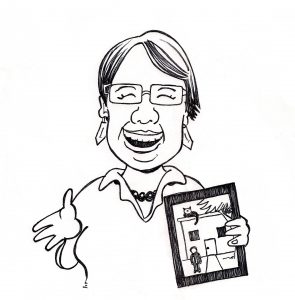
The image for this blog post was given to me by a stranger. I was speaking at an Autism Expo and I had a trade table with my books. When I finished speaking I went back to my table. There were loads of people at my table. A person walked up, got to the front of the queue and handed me a tiny drawing on a piece of paper ripped from a notebook. I asked ‘Is that me and Mr Kitty?’ The person replied that yes it was and then disappeared. I never saw them again and don’t have their name but their act of kindness and connection with me left a big impression. When I got home I found a frame and some red sparkly paper and framed it. It sits on my microwave and I look at it every day. 

That interaction demonstrates something magical and how people can come into your life, interact with you and make some change and leave an impression. These can be chance and brief encounters or entire relationships lasting many years. Whenever I talk about this topic I think of Polly. Polly Samuel was an autistic author and advocate who I had the privilege of knowing and also of calling a mentor and good friend. Polly remains the biggest catalyst for positive change in my life, ever. Without Polly I doubt I would be an author and advocate.

I met Polly at a course to enable autistic people to give presentations to schools. I actually have no idea why Polly went there as she was an accomplished and experienced speaker already, but there she was and for that I am immensely grateful. We became friends almost as soon as we met. Polly became my mentor. I learned autistic pride through knowing her. I learned to love and value myself as an autistic person and I learned that I had value and worth. It was Polly who encouraged me to write my life story and then who wrote a foreword for the book when I did write it and sent it to her publisher – now one of my publishers which carry I think 10 of my books now and have three more in production. Polly was my friend and mentor and she radically changed my world. Sadly she is no longer with us but I am eternally grateful for her gifts for me – especially the gift of self-worth and the gift of autistic pride.

There are also people who stay with you long term and make a difference. My parents have that role in my life. My parents have been there for me my whole life. You might think that is a given but I have a very fraught early adult life and many parents would have simply given up. I spent over three years in prison in the 1990s and even more in psychiatric hospitals. I used to be immensely self-destructive and sought only negative things. I imagine my parents would have really struggled with my negative path. My mum is autistic and has a fair whack of anxiety so I imagine when I was being self-defeating and self-destructive that anxiety must have been off the chart but she still stayed there with me regardless. 

I appreciate this as the support and love of my parents are probably the main reason I survived that time in my life and was able to make major changes in my life. Our relationship has been very challenging but now it is very good. I am a fan of repairing relationships when they need to be repaired and have worked with both my parents to build a strong relationship based in love, acceptance and respect. My parents and I are now extremely close which is lovely. Recently my dad told me that he called someone out on transphobia. I was so proud of him at that moment and I know that the driving force behind challenging the person was almost certainly his love for me. 

I like to think that when I come into contact with people it is a positive thing and that I can be an influence and catalyst for positive things for others. Of course that doesn’t happen all the time but I do want to make a difference. I think it is a goal we could all have to touch others (metaphorically) with love and kindness and make their world a better place for us having been in it. I like the aim to leave the world a better place when I leave it than it was when I cam in. It is an ongoing goal!  

Um, where am I?’ Thoughts on being disorganised and executive functioning 

I am autistic and ADHD. One of the experiences which I think probably relates to both of these differences is that I am by nature highly disorganised. I often find myself wondering what I am doing. I wander around my house having no idea why I am wherever I am! I always say I could get lost in my own house – and it isn’t a big house! I also say I could vague at an Olympic level – and I could! 

I think the reason for the vagueness and disorganisation is almost certainly my experience of executive functioning. Executive function skills are the mental processes that enable us to plan, focus attention, remember instructions, and juggle multiple tasks successfully.  The twelve elements of executive functioning are:

  • self-restraint, 
  • working memory, 
  • emotion control, 
  • focus, 
  • task initiation, 
  • planning/prioritisation, 
  • organisation,  
  • time management, 
  • defining and achieving goals, 
  • flexibility, 
  • observation and 
  • stress tolerance. I am actually quite good at some of these and dreadful at others! 

Challenges with executive functioning are a common experience for neurodivergent folks – we often demonstrate capability in some domains of executive function and not at others. I think I probably have issues with seven of the twelve elements!

While getting lost in my own house is quite amusing, challenges with some of these skills can be very difficult especially in the world of work. I can’t remember most things in my job. I forget what is said in meetings, I forget where tasks are up to and I have difficulties putting things together in my mind. This means that I need to practice a range of strategies to manage that. I keep a very regular, accurate and nicely colour-coded task list and update it several times a day. I can’t focus on large screeds of text – which forms part of my job – so put in place some strategies to manage that too. 

A good friend used to get annoyed with me due to these sorts of issues, especially my planning and organisation skills. Eventually she worked out that these issues were just part of what made me Yenn and so it was OK. The main challenge I find with this is that people think I am slack or incompetent and also that I have some choice in the matter! I really cannot do these things and it is not something I can learn. I find that even if it is impossible to ‘fix’ executive functioning issues that it IS possible to put in place effective strategies to address them.

I think the world at large needs to understand executive functioning and how quite a lot of people have difficulties with it. It is not a choice, I am not slack and it does not mean I am incapable of doing things like work and friendships. The more I learn about executive functioning the better I understand myself. It is not a failing and it is not a choice. It is good for neurodivergent folks to understand executive functioning issues and how it affects us as it enables us to understand ourselves and our experience better. And it is REALLY good for neurotypical and allistic folks to understand it as it helps them to understand us and avoid judgement. 

My strategies are helpful in this space and enable me to work in a fairly high level job quite effectively. It is an ongoing challenge though. Understanding  is key as is helping others to understand what it means.   

‘Rude’ – unhelpful assumptions about autism 

When I was a child I was always getting in trouble for being ‘rude’, for being too honest and saying inappropriate things. The weird thing was that I had no intention of being rude at all, I was just saying things how they were – in my mind at least. This is one of many areas where autistic people have assumptions levelled at us which are actually not true.

Autistic to my mind is largely a cultural difference. We speak a different language. Have you ever spoken to someone from a different country and their capability to speak English is OK but things get lost in translation? Well that is what things are like for me and other autistics in terms of communication. Things get lost in translation and we are misunderstood. When autistic people get together with other autistic people then these language issues tend to not be a problem. 

It is not like we communicate ‘wrong’ at all, just differently. But try telling that to the parent of a child who has told a stranger that they are fat or that someone should stop smoking because ti will kill them! Our apparent rudeness is often completely unintentional and we have no wish to upset anyone or be rude. The same goes for social skills. We do not socialise wrong, we socialise different. However there is a whole industry of trying to fix autistic people to make us communicate ‘right’ and socialise ‘appropriately.’ 

What actually needs to happen is for allistic people to build their understanding of autistic communication and socialising. So rather than criticising us and trying to somehow fix us they understand us instead. It isn’t that difficult to do this to my mind. I spent many years of my life trying to learn to speak allistic and I did quite well. I have quite good conversational neurotypical! If I can learn to speak neurotypical then I am thinking that neurotypical folks can learn to speak autistic! 

It can be very upsetting to be chastised for being ‘rude’ or socialising ‘wrong’. This is because it usually is not our intent to be difficult. We are just being ourselves and communicating in the way whatever higher power covers autism has intended. We are not wrong, we are different and different is fine. Over the past few years I have embraced my autistic identity and the things which come with it and I am happy to be me. And if I say something which is received negatively I explain that I communicate differently and that my intent was not to offend. And if the person I have inadvertently wronged has an issue? Well I have done my best.

It can help autistic folks to have a good working knowledge of the sorts of things that upset people (‘you are fat’, ‘I don’t like your shoes’ etc) because most of us don’t actually WANT to offend people but we also need to understand that we are not intentionally being rude or that we are being intentionally difficult. This is an area for advocacy and education.  

Managing anxiety – thoughts and strategies

Content warning: suicide

I am pretty much constantly anxious, I worry about everything from worrying that my emails aren’t sending to stressing about home maintenance. Anxiety is definitely not my friend as extreme anxiety can turn into psychosis which usually results in me taking years to recover and having to take months off work and spend a lot of time in hospital. I have attempted suicide before due to high anxiety. Because of this I get anxious about being anxious!

I want to share some of the things I do to address anxiety – they aren’t always 100% effective but they do help me. The first is simple: medication. I went through most of my life not having any medication for my anxiety. The problem was that whenever I was in hospital and under the care of a psychiatrist, I was psychotic. Psychosis trumps pretty much everything in mental health care. If you are psychotic it is also quite hard to express or articulate what is going on. Because of this I never managed to tall any hospital psychiatrists who were responsible for changing my medication that anxiety was destroying me! Then in 2021 I was in hospital and I was not psychotic. I explained to the doctor that my anxiety about the internet not working had resulted in a suicide attempt. He said ‘I will address your anxiety’ and instantly put me on medication for anxiety which completely changed my life! I still get anxious but nowhere near as badly and since then I have had no psychotic episodes. 

Another strategy is around thinking. A mental health worker once told me that if thoughts were making me anxious I should imagine that they were a person knocking on the door. I couldn’t help them being there but I could decide whether or not to let them in. I took this one step further and imagined that Donald Trump was at the door…and there is no way in the world I would let him into my house! I now just think ‘Eep! Trump’s at the door!’ Which works quite nicely. 

I also practice my own kind of mindfulness by watching relaxing scenery on YouTube. This works well – and my cat enjoys it too!

I don’t like when people say ‘oh don’t worry about that.’ If anxiety listened to logic then psychologists would all be unemployed! Problematic anxiety is of nature illogical.  If I cold just tell myself not to worry then life would be a lot easier and I would have spent a lot less of my time in hospital!

I do some deep breathing when I am really anxious. This helps. Anxiety for me is a very physical thing. I feel tight in my chest and belly and my heart races. So deep breathing is a physical means of addressing anxiety and helps me to slow down. 

I also often tell a friend if I am anxious about something as they can put it into perspective. I DON’T need to die because my internet isn’t working!  

Distraction is a big plus as well. This involves doing something enjoyable to occupy your brain. It works by taking your mind off the anxiety. Distraction is my go to mental health strategy and many other people find it helpful too.

I see a psychologist which helps. A good psychologist can make a big difference. It can take a while to find a good psychologist but a good one is a blessing. Finding one who understands autism and neurodivergence is really important. You can ask around your neurodivergent network to see who is good although being aware that different people may experience the same psychologist differently. 

Anxiety is not my friend. While it is a natural function passed down from our ancient ancestry for me it is more harmful than useful. I am much less anxious than  was but it is still an issue. Strategies are really helpful and you can build your knowledge of what works over time.  

Approaches and attitudes or going from desperate prisoner to absurd overachiever 

Today I gave a talk for TEDx Canberra. My second TEDx talk in ten years. It went really well and everything about it was good – don’t ask me, ask my speaker coach!! The talk involved a lot of preparation and self-reflection and it got me thinking about how I got to here. ‘Here’ being thirteen published books, a professional job, a large number of awards, hundreds of talks and all sort of other cool things – including two TEDx talks! I have an extraordinary life but I used to have an extraordinary life for very different reasons. I spent three and a half years in prisons and I have spent almost seven years in psychiatric institutions because I have schizophrenia. My life in the 1990s and early 2000s was as far removed from my life now as you could imagine. So, I hear you ask, how did I make that major shift?

A lot of the change related to my motivation and attitudes. When I was in my early twenties I actively sought out negative things and deliberately got in trouble with police so I could be institutionalised. My attitudes and motivation were 100 per cent negative. This changed in late 1999. I decided that a new millennium should equal a new life. I shifted my attitudes and motivation and this helped me to make some very big changes.

I started to seek out positive things. I remember when I was released form prison for the last time in February 2000 I threw out my address book because everyone in there was a drug user or criminal. I knew that if I stayed in the company of criminals that it would be very hard to escape that world.

I started to focus on positive things. I enrolled in university and kept my past a secret as I was ashamed of it. When I was in the throes of negativity I would happily talk about being in prison and self harming and wanted people to see me in those contexts but when I enrolled in university I didn’t want everyone knowing my sordid past.

The other thing I did was make a goal. Around one year after I was released from prison in 2000 I decided I wanted to be ‘ordinary’. To my mind that having a professional job, an education, a mortgage and a suit. I am not saying it was easy to change my life – it absolutely wasn’t. And I definitely don’t blame others for not taking a similar path to me. It was a huge challenge and for many years things could easily have fallen apart. I had a major substance abuse problem between 1995 and 2007, having issues with illicit drugs and alcohol. I lived in crisis accommodation and public housing and many of the neighbours that I counted as friends were petty criminals. Often the only thing standing between reverting to my previous life was my determination to change.

Some tips I can share – which you might already know but it can’t hurt to share them again – are:

  • If it feels wrong don’t do it. Simple but effective
  • Set positive, attainable goals and don’t give up if they don’t eventuate quickly
  • Surround yourself with people who have a sense of self-respect and who like and value you – and themselves 
  • Each day is a new day. If you make a mistake then join the club! We are all human. Just move on and resolve to not do it again
  • Be honest. This one often comes naturally to autistic folks but allistics can do it too! 
  • If you make a mistake own it. Apologise and try not to do it again. 
  • Cultivate a sense of pride, self-worth and self-acceptance
  • If you make a mistake view it as a learning opportunity 
  • Please feel free to draw form my example. My story clearly demonstrates that anyone no matter how desperate can change their life
  • Be very wary of the concept of ‘success’. It is very fraught. I never call myself successful. If I have to describe that about me I say ‘accomplished.’
  • Know that attitudes can change 
  • Know that your motivation and what you aim for tend to be the things you will end up getting. 

A place to call home (finally)

On Thursday I will have lived at Yennski Central for one year exactly. Yennski Central is a place I absolutely love and I often find myself saying ‘This is my house, I love it’. Yennski Central is one bedroom with a study. It is furnished with mostly nice things from IKEA (big thank you to my friend Lizbet for her IKEA-building expertise! I was a fairly inept apprentice who would hold up various bits and say ‘what does this do? And get extremely confused about the whole process!) I also have a LOT of art, postcards, posters and nice things. When I bought Yennski Central I was determined to like it and make it my own. Of course I am absurdly privileged to own a property on a single income and I am aware that for so many people – and especially neurodivergent people – home ownership is an unattainable thing. And it actually was for me for a very long time. Accommodation was a huge problem in the world of Yennski.

I was poor between 1992 and 2007 – in low-paid work or on benefits. Accommodation was a problem for a long time. I applied for the priority stream for public housing in 2003 and was granted it on the basis of my having lived in over thirty places ever the preceding years! I was also a prisoner between 1994 and 1999 and that had a big impact on my access to housing. It is almost impossible to get a rental when you have just been in jail and share houses are also often off limits. 

I lived in boarding houses and crisis accommodation for some time. Testament to the issue was the feeling I had when I moved into accommodation for young people with mental illnesses in 2000. The house was as crumbling mansion in Melbourne’s inner suburbs. There were multitudinous huge spiders in the house and I HATE spiders. I had 13 housemates –  some of home were very challenging – and the house had staff and strict rules. If I had to live somewhere like that now I would be horrified but at the time I thought it was my dream home!

I lived in places with people with major drug problems, I lived briefly with a partner who stole from me and assaulted me. I lived in public housing for almost four years and the neighbours were mostly drug addicts and alcoholics and I even had a stalker there. She would glare at any female visitors I might have – including my mum! I hated my public housing flat with a passion and it was when I lived there that I was determined to move out and get a ‘proper’ job (i.e. a well-paid and full-time professional position.)

It might seem absurd for an autistic and ADHD ex-prisoner with schizophrenia would even consider this idea of a ‘proper’ job and the financial independence it might involve. However I am nothing if not determined so I set my sights high and I actually got what I wanted. In 2007 I moved to Canberra to start a dramatically different life. Less than two years after I moved I bought my first property. This one was actually not very nice. It was originally sued as public housing and it was built the same year I was born and had a lot of problems, especially plumbing problems. My schizophrenia made me think that it was haunted so I was always scared when I was there. I have two major episodes of psychosis which can be reasonably ascribed to extreme anxiety related to my apartment. I hated the place. In 2020 I finally sold it. I had thought it would be impossible to sell and I would be stuck with it for eternity  so I put a low price on it. In fact I accepted an offer in less than two days and settlement went through shortly afterwards. I was free!

I rented for two years after that as I was still quite unwell and wanted to ensure I would be mentally ready to purchase a new home. I bought Yennski Central in August 2022 and moved in six weeks later. And yes when I rented I was an amazing and responsible tenant! When I was younger I was the tenant from hell but I guess things change.

I think accommodation is a big problem for a lot of autistic and neurodivergent people. Work can be an issue and obviously work feeds into your approach and capacity around housing. Also people with children can be discriminated against in rental properties and especially if they have autistic kids. Accommodation can be really stressful for autistic people. For me, renting and owning are stressful for different reasons. Renting is stressful because you are always at the mercy of the real estate agent and owner. There is also the worry or accidentally damaging the property – multiplied when you have children or pets. Owning is scry because it is such a big commitment. What if you lose your job? What if interest rates go too high for you to pay the mortgage? 

I am very fortunate to have my home. After 48 years I finally found a place to call home. I wish the same for everyone.


How do I do it? Managing an absurd workload and avoiding burnout 

I work full-time in the public service. In addition to that I have written 13 published books, I give around two talks per month, mentor people, publish a regular blog post, contribute to magazines and journals, do consultancy work, give endorsements for books, manage a social media presence with a direct reach of around 35,0000 people, publish weekly Yemes and give media appearances. My workload is unlikely and possibly untenable but I somehow manage it, mostly without any burnout or stress.

I think the main reason I manage such an absurd workload is that I love what I do. I love pretty much every single element of my workload. I love my public service job and I love my advocacy work. My work is my passion. Autistic people often experience intense joy from their passions and I am no exception. My love of my work empowers and enables me to undertake a huge amount of things because I enjoy them. There is also the fact that much of what I do helps people so that energises me as well. I spent many years not being very helpful to anyone so now the fact that I get to support others with my work inspires me to do more. I regularly receive positive feedback and encouragement from people who have benefitted from my work and this makes it easier to do whaat I do. 

A friend once told me the reason I avoid burnout is that I don’t mask. I think she may have been right. I have no time for masking or trying to camouflage my true self. I take the opinion that if people don’t like the real Yenn then they can go away! This certainly makes life easier. I used to do a lot of masking when I was younger. In fact I did it so much that I lost touch with my true identity and it took years to get to a place where I knew and liked my true self. These days what you see is what you get and it definitely makes life easier! The energy it takes to hide yourself is intense and I imagine if I was doing that then I would be much more prone to burnout.

Another reason that I can manage my frankly ridiculous workload is that I am focused and that I am quick and decisive. Added to that is the fact that I have prodigious talents in the areas of writing and public speaking. While many people would be daunted by the prospect of writing a book or giving a TEDx talk, I find these things enjoyable. It’s funny because people say ‘wow, I couldn’t do those things you do’ but they have children. While I can hop up on stage and give a talk at the drop of a hat, raising children is something I definitely couldn’t do so I am equally impressed at others’ capability to raise children! I guess it just shows that everyone has different talents and we are all needed. And I suspect thee world  needs more good parents than authors or public speakers!!

I actually love my work and I would be very sad if I couldn’t do any of it any more. It is a great joy and privilege to get to do all the things I do. I am grateful for the opportunity to try to make the world a better place through what I do and very grateful that I am capable of doing everything I do. Long may it continue!

The price paid – living life with schizophrenia and medication

I have schizophrenia. In 1995 when I was 21 I self-medicated with a range of illicit drugs. Drug use became my passionate interest. I was described as the most prolific and generous drug addict in my suburb. Being high was a full-time job. People told me that drug use could cause mental health issues but surely that wouldn’t happen to me? I was 21 and invincible. Nothing bad could happen to me! Sadly that was completely untrue. After being evicted and facing the real prospect of sleeping under a bridge I became psychotic. I ended up in hospital and thus began almost thirty years of illness. I have been in hospital more times than I could count. I have lived in countless residential mental health services and had hundreds of mental health workers over the years.

My schizophrenia is described as treatment resistant. This means that I take the medication but still get unwell. I have tried almost all the anti-psychotic medications. Most of them do very little. I think if my illness was a person it would be a bully with a very bad attitude! The medications are no fun. They all have significant side effects. I am on the final drug now, Clozapine. Clozapine is the most effective drug for schizophrenia. It is given to people for whom the other medications don’t work. Sounds good doesn’t it? Well it is effective but it is also totally brutal. 

The ‘mild’ side effects of Clozapine include significant weight gain, muscle tremors, drooling and sedation. I go to bed at 7pm each night and sleep through the night. It is actually great to get reliably good sleep even if it is a bit debilitating to spend 11 hours asleep every night! However, I said goodbye to my evenings some years ago! The weight gain is a nightmare. I have to be extremely careful not to put on weight. I can have almost no sugar or carbs and still put on weight. When people offer me a cake I really wish they wouldn’t! The drooling side effect for me is confined to the nighttime so I am OK with that and the muscle tremors are rare – although I remember one medication made me poke my tongue out constantly which was embarrassing to say the least!

Clozapine also has some very scary side effects. One of them is extreme constipation. I googled deaths due to Clozapine once and a lot of people had died form bowel obstructions due to extreme constipation. The other really scary side effects are life-threatening heart conditions and something called neutropina which is where your white blood cells are deficient. It means you could be killed by what would usually be a minor infection.

So why would I want to do this to myself? Why would I take this medication which threatens to shorten my life and has a lot of very negative effects on my existence? Most people who know me have not seen my experience psychosis but I have and it is not nice. It is like a waking nightmare. Clozapine has not only kept me safe and out of hospital but it has freed me from a lifetime of fear. I used to be unable to sleep on top of the covers in bed in summer even on the hottest days. This was because I was terrified that the ghosts would attack me and I would be much safer under the covers. I also used to be unable to have a mirror in the bedroom because I thought that looking in the mirror at night would summon the ghosts and I would see them in the mirror, behind my back. This was just my resting normal. I was not psychotic at the time and would have described myself as well. Clozapine has saved me from that near constant fear.  

I actually hate that I need to take medication. I want my illness to leave me alone and go away. I often question the diagnosis, despite knowing deep down that it is correct.  I am grateful that there is medication and that it works but at the same time I hate that I have to take it. It will probably shorten my life which makes me angry and sad. If only 21 year old Yenn had listened to the advice of others about their drug use! But they didn’t and what I have is what I have. I am grateful to be able to do all the thongs I do though. It is quite wonderful.