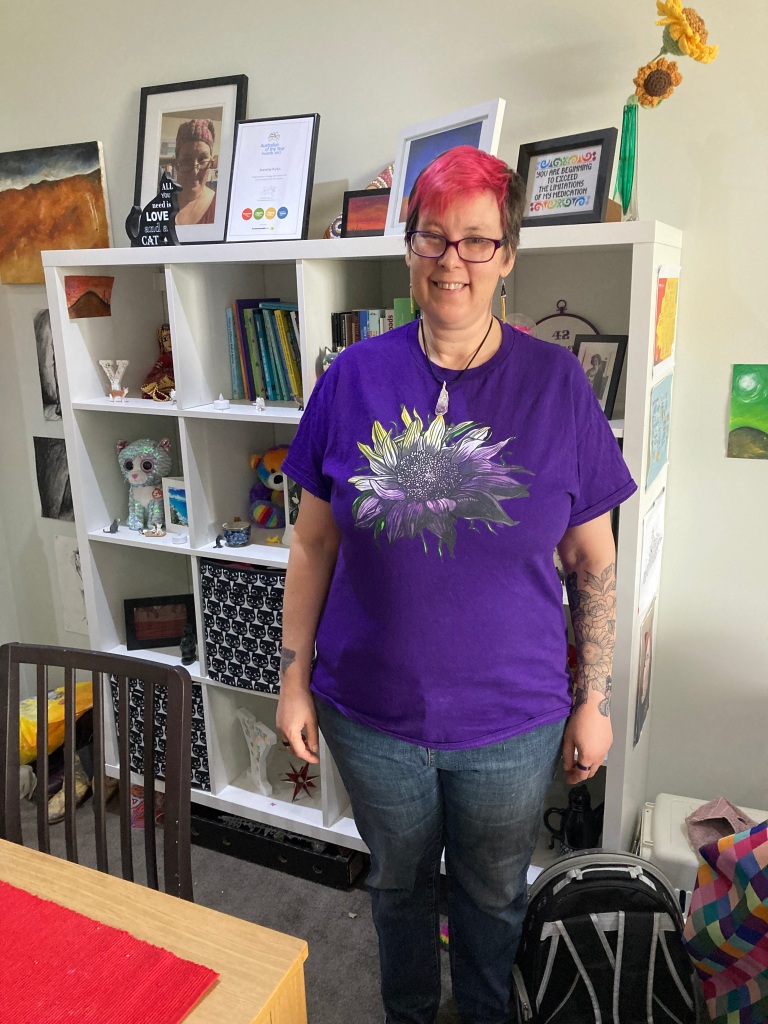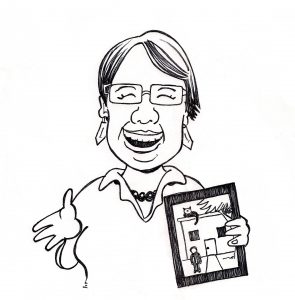
Autistic AF

I was diagnosed as autistic in 1994. At the time it was considered a rare thing. In Victoria, where I lived, there were two clinicians who could diagnose autism – a psychiatrist and a clinical psychologist. When Igot my diagnosis, I was told that I fulfilled all the criteria in the DSM IV (the diagnostic manual at the time) for autism (or Asperger syndrome as it was known then). Not some, many or a few but ALL the criteria. In my life I have only met one clinician who didn’t think I was autistic and that was in 1996 when autism was quite a new thing and many psychiatrists had no idea what it meant.

As a child and undiagnosed Autistic person, I knew I was different to most of my peers. I knew because people told me – mostly bullies sadly! I was desperate to be accepted and tried – mostly quite unsuccessfully – to mask and appear more like my schoolmates. As a young adult I thought I had mastered the art of masking and seeming socially acceptable, but it came at the cost of me having any sense of identity or pride of who I was. I didn’t ever want to look ‘different’ and if I thought something would make me seem more like the majority of humans I would do it! I didn’t accept my autism diagnosis for many years because of this.

I did thankfully learn some autistic pride and ended up accepting who I really was – as demonstrated by the publication of my autobiography in 2006. I am now very much out loud and proud autistic.

The purpose of this post is about self-reflection and understanding. I have recently realised that I present to the world as autistic in a big way. The reason I struggled at masking in my teen and early adult years was that my natural presentation to the world is, well, Autistic as f*ck! I only just worked this out. I mean self-reflection is one of my skills but it is hard to be objective about my own presentation as I am seeing from the inside looking out and not the other way around!

People usually respond to me in a way that I now understand means they think ‘ooh this person is different….’ There is a reason that only one clinician in my life has doubted my autism diagnosis – and I have had hundreds or mental health workers of one form or another over the years.  I could mask until the metaphorical cows come home and people would probably still think ‘ooh this person is different…’ These days I love my difference. I love that I fulfilled all the diagnostic criteria for autism in 1994 and I love that I have an accomplished and fulfilled life complete with all my various differences.

I am so proud to by me obviously autistic self. I actually have no idea what motivates neurotypical folks and how they present to the world. If someone said they would pay me lots of money to play the part of a neurotypical person I would struggle – and this is probablty a good thing. I am (very) different not less and I get to share my perspectives with the neurotypical / allistic folks to help them understand autistic perspectives through viewing my experience and how I present to the world.

It took me a long time to understand that I am ‘different’ on any deep level but now I do, I think it is awesome. I have also become very confident in my middle age so if someone has an issue with my ‘difference’ and wants to give me a hard time than I really don’t care. I don’t feel bad like I used to when people attacked me for being visibly ‘different’. I either ignore the person or I call them on it, depending on the situation. I wish I had that confidence as a child, teen and young adult but I do now so that is OK too.

I love that lot of autistic young people these days seem to be so much more confident that I was at their age and that they have a ‘family’ of other autistic people. I would never have imagined that happening when I was younger. A sense of pride and self-acceptance is a wonderful thing.

I am Autistic as F*ck and happy and proud to be so. Difference is not only not less, but it is awesome! So, I share my pride in my difference and the fact that I navigate the world as a visibly different person and an out loud and proud autistic and ADHD (AuDHD) person and someone who also belongs to a number of Queer identities and has schizophrenia. Own your pride, own your difference and keep being wonderful.

History – or being an ethical person with an unethical past

There are two things which people don’t believe about me when I tell them. One is my age. Apparently, I look like I am in my thirties, but I am in fact fifty. The other one relates to what I view as my ancient history. Between 1994 and 1999 I was a criminal. Of course, this is now so long ago that it doesn’t show up on a police check, but it impacts on my sense of who I am and wish my actions in those years had never happened.

When I was (actually) 30 I met autistic advocate and internationally bestselling author Polly Samuel. I had only recently embraced my autism diagnosis. I was very poor living in public housing with a stalker for a neighbour. I was also studying at university in order to get a degree so I could get a ‘real’ job and move out of my public housing flat. I met Polly at a course for autistic people to enable us to work giving presentations on autism to school students. As I was new to the autistic community I hadn’t heard of Polly. She told me she had written nine books, and I thought this was very cool. We soon became friends and Polly became my mentor and a huge catalyst for positive change in my life.

At the time a lot of people had told me I should write my life story and I always declined. I thought if I published my story it would result in judgment and criticism, something I preferred to avoid! Polly said to me that when she gave talks to parents of autistic kids there were always parents who sat up the back and didn’t stay for the cup of tea at the end. These were the parents of autistic kids involved in the criminal justice system. Polly said my book would be for those parents. It took me half a second to realise that was my own parents, so I wrote the book!  

The book was published. This gave me a lot of confidence leading me to apply for – and get – a job with the Australian Public Service. I had to answer a lot of questions about my ‘interesting’ past, but my employment was approved. I was a public servant for 17 years and it enabled me to buy property and became completely independent.

I call myself a highly ethical person with an unethical past. I regret the things that happened in my past despite there being mitigating circumstances. I think my criminal history related to system failure and a lack of appropriate services more than me being evil. However, it is important to note that I did have a choice, and I made the wrong decision on a number of occasions. I think that criminal behaviour has both an individual and societal component. It is no surprise that research has shown that certain postcodes have considerably greater rates of criminal behaviour and victimisation than others and that these postcodes are in areas of economic and social disadvantage.  

I know about institutions. In between prison, psychiatric hospitals and mental health residential care I have spent ten years – or twenty per cent of my life – in institutions of one kind or another. There is a temptation to institutions. Being independent comes with it a lot of responsibility and hard work. I have a mortgage and not a lot of regular work. Having my own place is amazing but it would be nice if I didn’t have the responsibility associated with needing to find ongoing work in order to finance my independence. Of course, I have no intention or desire to enter institutional care, but I do understand the attraction and why I spent so many times in institutions as a young person.

I don’t like my history. I am ashamed of it and if I could go back and somehow fix it I would. I do think it has given me a lot of empathy and understanding for others that I probably wouldn’t otherwise have. I know a lot of autistic and ADHD people end up in trouble with the law for reasons related to society not being inclusive and there not being appropriate services to support them. I remember many court appearances when I was in my twenties. My lawyer, Vince, would show the magistrate photos of my artworks and explain that prison wasn’t appropriate and the magistrate agreeing and then saying that there were no services that were appropriate to supporting me so they sent me to jail. Sadly, this sort of thing still happens thirty years later. This is an area where I haven’t done a lot of work, but which is really important.

Kitty therapists

Anyone who knows me knows that I love cats…. A lot! For most of my life I have had a feline friend. Being around cats is my happy place. They are a better support than a dozen psychiatrists and they make me feel good simply by existing. I got my first cat, Smokey, when I was a child. Since then, I have had Sensei, Monty, Hieronymus Bosch, Tilly, Mr Kitty, Major Tom and Sunflower. I have had friends tell me that when they die, they want to come back as my cat! All of my cats have been rescues – I figure there are enough kitties in the world needing homes that I don’t really want to pay someone a lot of money for a cat of a specific breed. I mean they are all cats, whatever they look like!

Sunflower is my current furry friend. She is such a sweetheart. Sunflower doesn’t have an ounce of aggression in her. She is gentle and sweet. I adopted her from 4Lyfe Rescue in Canberra. The foster carers said she was a very uncomplicated cat and that she is. When I take her to the vet, she makes friends with the vet and explores the treatment room! By comparison, when I took Mr kitty t the vet he would try and attack the staff and run away! In fact, one vet asked me if I boarded Mr Kitty because if I didn’t, I would only need to get him vaccinated every three years not every one year. I think they were keen to avoid contact with him! I used to have to put on big gauntlets and hold Mr Kitty while the vet examined him and gave him his vaccination! I don’t think any vet ever managed to take his temperature.

Mr Kitty was the most difficult cat you could imagine but I loved him so much. He wasn’t generally aggressive with me, just everyone else. He loved me and our bond was so strong. I got Mr kitty as a deliberate mental health strategy. Between 2010 and 2013 I was very unwell with schizophrenia – lots of hospital stays and general misery and unwell Yennski. I had a friend at the time who rescued cats and dogs. She kept saying I should get a kitty. I kept saying no because I worried that a cat might damage my house! Then one day I was home felling utterly miserable. I went out to get the mail and there was a little tabby cat sitting on the wall. I gave kitty a cuddle for some time and when I got inside realised that when I was patting the kitty, I didn’t feel unpleasant any more. I called my friend and asked her to bring me a cat.

She did better than that – she brought me four carriers full of kittens and one with a big grumpy black cat. The kittens were totally adorable, but it was the grumpy black cat that I ended up with. I picked him up and held him close. He immediately snuggled in and purred. He was mine and I was his. My beautiful Mr Kitty who was my mental health support cat and who I had for a wonderful seven years. He destroyed my carpet and vomited on pretty much every surface of my house, but I loved him so much. Sadly, my beautiful Mr Kitty had a heart condition, and I had to say goodbye to him in 2020, when I was in hospital myself. He was a complete menace, destructo-kitty and also the most wonderful cat a Yennski could have. Whenever I went to bed Mr Kitty would sleep next to me on the pillow. I would put my arm over him and cuddle him and we would both go to sleep. He was a prince among felines, and I still miss him. I am grateful for his support as he was a wonderful therapist.

Sunflower is very different. She is quiet and sweet and affectionate. She likes everyone. She will come up to me and flop on the floor which is Sunflower language for ‘please pat me now’. She is playful and loves toys. She is terrified of the outdoors. She has not attempted to go outside since I have had her – almost two years. She follows me wherever I go in the house and gives excellent feline supervision for such activities as having a shower or going to the toilet! I call her my feline overlord and my black and gold brand cat (as she is a dark tortie, so is black and ginger). Sunflower is the best thing in my house by a long shot.

Whenever I come home she follows me into the bedroom and gets a big cuddle. She also likes to give kisses, mostly just to me. When mumma cats have kittens they lick them for grooming and affection. Sunflower loves to lick my hands – and sometimes my head! When I got her she had five kittens. She is the first cat mumma that I have had and I think it is one reason why she is so affectionate. She is desexed now so no more kittens.  

Cats are just the best. When I die, I want to go wherever the cats go!

A lot of other autistic people love cats and other animals. It is a common autistic characteristic. I don’t get human body language, but I do understand nonverbal cues of cats. Cats are easier than humans to my mind. When I was younger if I went to a party, I would talk to the pets rather than the humans! I love how cats make such a difference to me. My mum always worries that I will turn into a crazy cat person and end up with ten cats! While I actually would like ten cats, I don’t think it would be fair on the cats to live in my quite small apartment! I think mostly cats like to be the only cat in a household.

So, cats are amazing therapists at least in my experience. I remember when I just got Mr kitty I had been going to a mental health respite place. They called and said they had a spot and would I like to come in for a couple of weeks. I said I didn’t because I had a cat which made every day mental health respite!

…And Sunflower sends you all some purrs. She is a very purry cat!

Rejection sensitive dysphoria – what it is, what does it feel like and why people need to know about it  

I recently discovered something which made a lot of sense to me and which I wished I knew a long time ago. This is something called Rejection Sensitive Dysphoria (or RSD). Basically, it means that feedback can be experienced as a traumatic experience. People with RSD often become ‘people pleasers’ in order to avoid criticism. It can impact across many domains of life, such as in intimate relationships and friendships and in the workplace or in education.

RSD is apparently more common amongst ADHDers and in my own anecdotal experience AuDHD folks too (i.e. people who are both autistic and ADHD – which includes me). RSD can make social situations very stressful and result in people being withdrawn socially and being perfectionists and worrying about making errors. I had a job once where my manager had a lot of mostly quite difficult feedback for me, and I got so anxious that work went from being one of my favourite activities to being one of the least! I left that role and felt a lot better, but the experience had an impact on my confidence and mental health which took a long time to recover!

These days I tell any new managers that I have RSD and what it means for me at work. Being aware of the issues is helpful and explaining what it is to people that don’t know is also helpful.

I think RSD is related to anxiety – or maybe it can be seen as a trigger for anxiety and self-doubt. For me it is quite debilitating. It makes me afraid of situations – like performance discissions at work or evaluations of my presentations. It doesn’t matter if the feedback I am getting is positive, the very process of evaluation and telling me what is going on – even if it positive – causes high stress. My experience of RSD is similar to a trauma response. It is not a flaw or failing and it needs understanding rather than judgement. I have been criticised as being a ‘snowflake’ and being ‘unable to manage your emotions’ in the past due to my RSD. This kind of response is not only unhelpful it is also hurtful and not appropriate.

RSD is a relatively new thing in terms of it having a definition and name, but I think it has always been around. People need to understand about what RSD means – and especially managers in the workplace and teachers and tutors in school / university / higher education.

These days when I start a new job, I tell my manager about my RSD and explain what my experience of it and my needs around it are. It can be the source of criticism a being seen as some kind of character flaw which is unhelpful and unfair. I cannot make myself stop having RSD no matter what people say but I can build my confidence and competence if I am supported appropriately and understood! RSD can cause significant anxiety and feeds into processes of anxiety like rumination and catastrophising.

I try to address my RSD issues in a number of ways. I try to ensure that I am prepared for feedback before it happens as far as possible. I have been known to take a support person into meetings which I fear will involve harsh criticism and I try to keep an open mind about feedback such as when one of my talks has an evaluation at the end! In fact, it is rare for me or receive negative feedback for my talks or for my paid work at the moment, but I still worry!

I undertook ‘people pleasing’ for many years. I was terrified of confrontation or criticism from friends, partners – or anyone! I did everything I possibly could to avoid arguments. I am ashamed to say that I often wouldn’t challenge a friend or partner even if they were saying bigoted or disrespectful things. The issue of being challenged or criticised outweighed my need to challenge unethical or hateful comments. Even now I struggle to challenge people who say disrespectful things. I fact I think I solved these issues by only having respectful and inclusive people in my world!

People pleasing is a big issue. I know it has been and still is for me! I also think that people need a greater understanding of RSD, so they don’t think someone is being overly sensitive or that they are somehow deficient in ‘social skills’. More people knowing about RSD would be beneficial because it would mean that people can make allowances and view people from a kinder and more respectful perspective. Greater knowledge would also enable people who have RSD to understand that they do as I suspect a lot of people with RSD don’t know about it yet and it is likely causing a lot of stress and misery.

I am grateful to have my RSD identification as it allows me to understand myself better.

I don’t feel like…. Identity and self-reflection and perceptions of others

I am a very much out loud and proud:

  • Autistic and ADHD (‘AuDHD’) person
  • Disabled person
  • Non-binary person, and
  • Asexual person – among other things.

I talk about pride and inclusion and respect and identity all the time. The weird  thing is that when I reflect on who I am I don’t see any ‘difference’. I am me. I don’t feel Queer or Autistic or anything else. My identities in these areas are often based on the discrimination I experience and my sense of alienation from typical society but if you asked me what AuDHD ‘feels like’ I would struggle to tell you. I am just Yenn.

I spend a fair amount of my time doing public speaking and talking about intersectionality and identity and mentioning how I am proud to belong to my various ‘groups’. When I speak at these things I am often asked about my identity, and I really struggle to know what to say in any sense of knowing myself as a member of intersectional groups.

I am reminded of my ‘difference’ when I speak with bigoted or narrow-minded people. I was a guest for a research event at Parliament House a few years ago. I was attending with an autistic friend and two neurotypical people form the same organisation I was representing. I got talking with a woman who was a senior executive in one of the big four banks. I thought we were having a good conversation and certainly did not feel ‘different’ while speaking with her. And then the executive turned to my neurotypical college and said, ‘oh she’s very articulate isn’t she’ (about me). I was horrified. I felt a that I was an equal with this person who apparently thought it was amazing that I could hold a conversation. Ugh. Sadly this was not an isolated incident.

I know I am ‘different’ to the cis gender folks, the neurotypical folks, the heterosexual folks. I really do know this, but I don’t go through life reflecting on this. It only really affects me when I meet someone who treats me with disrespect, hatred or infantilises me. Inside I just feel like Yenn, and I am equal to everyone else in the world. Why wouldn’t I be? But I get othered all the time ad face all manner of disrespectful and poor treatment based on differences that I am barely aware of. I hope that I never do any ‘othering’ to other people. I do belong to a few privileged groups in that I am white and financially secure and educated. I don’t think I ‘other’ anyone based on this, but it is likely that I do so, albeit unintentionally. Please do let me know if you see me doing any othering!!

It comes down to that disconnect between what others external to me are seeing and what I am seeing in relation to myself. I know from people’s comments that my fashion sense is pretty idiosyncratic and the way I communicate is a bit ‘odd’ and my love of cats and Star Trek might be a little atypical but to my mind this is just being me and is totally natural. I often look at other people and make my own assessments – they might seem very cis gender in their expression, they might engage in odd and possibly stereotypically neurotypical activities like small talk and dating! These things baffle me and seem very odd but lots of people seem to want to do them.

I suspect that maybe everyone’s view of who they are and the view of them from other people are quite different. I don’t think you can make an accurate assessment of a person’s character through looking at what they wear or other ways they express themselves Making assumptions is not such a good idea! I try not to do it, but I think most people are probably guilty of making assumptions when they meet someone. I think the key strategy to address this is to be aware of it and try to challenge it when you find yourself doing it.

Enough about expression… I think there is clearly a disconnect between my view of who I am and the various intersectional groups that I belong to and that or other people. I don’t ‘feel’ autistic, but I clearly am, and I don’t ‘feel’ asexual but I clearly am. I actually feel like Yenn, but Yenn who has a number of identities and elements to my character and how I express myself, even if I don’t ‘feel’ like that.

Nerd and proud of it!

[CW – bullying]

When I was a kid pretty much everyone at school hated me – or so it seemed. The bullies had a lot of cruel names for me. The most common insult was that I was a nerd. I enjoyed schoolwork and learning which apparently was not what I was supposed to do according to the other kids. I loved science fiction and studying, learning languages and following my various autistic passions. I hated being a ‘nerd.’ It was my least favourite insult – and there were a lot of insults! Poor little Yennie had a hard time at school. I will note that I wasn’t really nerdy in terms of studying. I am proud to say that I have a Master’s degree and I have never studied for an exam in my life. The information just went into my brain, and I downloaded it to the exam paper when required! Just one of my nice Yenn quirks!

Anyway, being nerdy was always viewed as a bad thing – both by those who called me it and by me. I would have loved to have not been a nerd, but I had no idea how to do that!

When I was diagnosed with autism at the age of 20 in 1994, I misinterpreted the diagnosis to mean that I had a pathology which made me a nerd! Obviously I didn’t want this. I was in major denial about my autism diagnosis for some years. I really didn’t want to have what I viewed as a diagnosis of nerd! The autism ‘label’ meant I was officially a nerd or so I thought, and I really did not want that as part of my identity.

Flash forward thirty years to middle aged, cat-loving, quirky, creative Yennski. I have learned to like and embrace my autism and my autistic identity. I am strong in my sense of who I am. And I love being a ‘nerd’. In fact, I am proud to be a nerd!   

I am now an eighteen times published author, I love learning, shiny things and science fiction! In fact, my current passionate interest is about as nerdy as you can get – The Borg in Star Trek! I happily embrace my nerdy identity. I actually love that I am a nerd and a geek. These things which were used as insults have now happily and proudly been assimilated into my self-identity (Borg joke!)

I used to try and mask my true self, my own sense of who I was. I was quite good at this to the extent that I lost track of who I actually was for a while. Now I don’t mask at all. I was giving a talk yesterday in the USA and I reflected that I just might be the most obviously autistic person in Australia! (Although I think I may have some competition in that space.) I love my autistic quirks, my Yennski identity. I am proud to be who I am – Queer, Autistic, ADHD and all the other good sorts of things that come with being Yenn.

An autistic friend once told me the reason I don’t get burned out is that I don’t mask. With me, what you see is what you get. I love that I have got to that point in my life. At one time I was so adept at masking that I didn’t really know what the ‘real’ Yenn looked like. I actually really like the ‘real’ Yenn – nerdy qualities and all! I can’t imagine going back to masking. Being me is pretty amazing and one of the reasons it is amazing because I embrace who I am.

So, I say to everyone, embrace yourself, your ‘nerd’, your autistic or ADHD or whatever other identity you might have. Being true to yourself is a lovely thing. So yes, I am a nerd and proud of it. (And ‘We are Borg. You will be assimilated. Resistance is futile.’ 🙂


Autistic passions and interests – good ones, negative ones and autistic joy

I often comment that autistic passions can change the world. And they can absolutely. Greta Thunberg’s passion is for saving the planet, Grace Tame’s passion is fighting to achieve justice for survivors of childhood sexual violence. Hannah Gadsby, Tim Minchin, Einstein… the list goes on. In fact one of my passions is autism advocacy and while I am no Hannah Gadsby or Grace Tame, I think I have made a difference in this space over the years.

Passions can be amazing. They can consume us and inspire joy and happiness just from thinking about the topic we love. I have had number of passions over the years: Dr Who, fungi cats, nuclear war for some reason, police and crime, Harry Potter, being a public servant, autism advocacy and more recently the Borg in the Star Trek series. Some of these passions have definitely made the world a better place – namely my passion for advocacy and probably my passion for public service. However, some of my passions were actually negative ones – the fascination with nuclear war was pretty negative but did not yield any damage to me or anyone else. However, one of my passions had a bunch of negative consequences for myself and others which involved being fascinated by police and prisons and crime.

We don’t generally talk about negative passions, but they do exist – a fact I know all too well. Between the ages of 19 and 25 my passion was around violent protests and then being caught up in the justice system. I spent almost four-years in prison as a result of this and worse still I victimised others. This is one of the worst outcomes of a passion that I could think of. Occasionally I come across other autistic people who have a dangerous or damaging passion. To my mind it can be helped by a harm minimisation approach or by transplanting a different passion which is less damaging. I do know it is a lot easier to metaphorically flush your life down the toilet than it is to make it better again. All of this happened between 25-30 years ago but it still haunts me and fills me with sadness and remorse.

Another thing about passions is that they can be all-encompassing. My current passion – and it is a doozy, the Borg n Star Trek – takes my attention a lot. This is great and fills me with joy, but I need to be very careful when focussing on my passion that it doesn’t encroach on my paid work! My current passion just arrived unheralded and was met with much joy. Most of my burning passions in the past have started like that. I don’t think that my current passion will change the world but gee it is lovely. When I am engaging with my passion I am totally engrossed. I would happily pursue my passion all day – and probably all night too! I have printed off dozens of Borg pictures – including the one accompanying this post – and put them up around Yennski HQ. I have ordered a bunch of Borg merchandise and am eagerly awaiting its delivery. I have to allocate time on workdays that it is OK to focus on my passion.

Having a passion, interest or fandom is one of my favourite things as an autistic person – and as a human. I cannot describe how lovely it is. My parents said when I was a kid and had a passion, I absorbed information as if by osmosis. We didn’t have the internet then but somehow, I managed to assimilate lots of information (Borg joke!!) Passions can form the basis of a business or career for autistic folks. One thing about passions is that they can vanish as quickly as they arrive. I have a friend who had a passion for making cheese. Her cheese was absolutely amazing as it was her passion, so she devoted her considerable talents to making cheese. After a while her passion shifted focus to something else and cheese was her passion no more! I was the same. I had a significant fandom for the Harry Potter books and movies. I lost that passion because the author of those books turned out to be a transphobic bigot and couldn’t manage even looking at the books. It was a sad moment indeed and probably an unexpected impact of transphobia!

I do love my passions and am delighted to have a new one. It is almost like having a loving relationship but even more so. It excites me, engages me and inspires me. I actually don’t know how to explain autistic passions to someone who does not experience them. A passion fills my soul with joy. I would happily experience my passion all day every day. The concept of autistic joy relates in this space. It is an abustle gift and one of the many reasons that if someone found a ‘cure’ for autism I would decline.  

25 years ago and now… reflecting on my ‘interesting’ history

I am a criminal. Well technically I suppose as my most recent justice-related issue happened in 1999 and I have been a very ethical little Yennski for some years. My troubled history is not something I am proud of – in fact it is a cause for great shame – but it is part of made me who I am now.

I don’t talk about my criminal past a lot. My most detailed discussion of it is in my autobiography which I wrote 6 years after my most recent conviction at the time. I decided in 1999, while still a prisoner, that a new millennium should equal a new life for Yennski. And it did, absolutely. I changed my character, my focus in life and my behaviour. I went from someone with no sense of responsibility or consequences to who I am now – although it took a while.

People ask me why I committed crimes. Was I a ‘bad’ person? Did I want to intentionally hurt others? Why would a nerdy university student and socialist want to get involved in such dark and unethical things? There were a few reasons. The first was a partner I had who was a very scary criminal. I was a naïve AuDHD twenty-year-old and didn’t realise how dangerous this person was and so I went along with his plans. By the time I realised how dangerous he was I was in too deep. I was afraid to leave him but I didn’t want to do crimes with him either. We ended up committing two robberies and I went to jail and never heard from him again. I was at once wracked with guilt for the crimes but also relieved that I didn’t have to see this man any more.

I was initially in jail for six months. When I was released, I was traumatised and self-medicated with every illicit substance I could get my sad little hands on. Extreme drug use for some time and homelessness resulted in me becoming psychotic and gaining a schizophrenia diagnoses – which I have to this day after thirty years and which still gives me trouble even now. I ended up in hospital in 1996 and had a delusion that jail was a cure for my significant depression  – I remembered all the older women in prison mothering me because I was so young and vulnerable. Because of this delusion when I was in hospital I committed crimes in order to go back to jail which I thought would fix my depression. I was successful – not at curing my depression sadly, but in going back to jail! I spent the next three years being unwell and institutionalised. I was released in 2000 for the last time.  I became a different person – more similar to the current Yenn.

In order to survive as an AuDHD prisoner I masked constantly. I figured out as soon as I got there that prison was like a malevolent high school where the bullies can kill you. I knew about being bullied and didn’t really want to go through it again, so I worked out how to behave as a criminal – the ‘rules’ of the criminal world, what upset criminals and what sorts of behaviours and attitudes where expected and thus I successfully avoided being victimised. It worked but it came at the expense of my sense of identity – I didn’t know who I was because I masked almost constantly for five years.

I survived. Actually, I thrived. People used to say I was a troubled soul. The messaging changed as I changed. When I enrolled I university in 2001 and got prizes and high distinctions people said I had ‘landed on your feet’. These days people say I am an anomaly, an overachiever. Some people even find my achievements intimidating! I am a lot happier than I was when I was younger and making bad decisions and being in danger. The most frightening thing that happens to me these days is going to the dentist!

My issues these days around my past and more related to shame and remorse and guilt about what I did in the 1990s. The fact that I have a criminal history can add an element of stress to applying for jobs and getting a police check! (And by now my police check comes back with nothing as my convictions are considered spent. I have never been denied a clearance or card due to my history, but I have had to answer a lot of questions about my past!! I don’t begrudge these checks as you wouldn’t want a paedophile working in school or a terrorist working in the police force, but these checks do add a lot of stress to my working life as I always worry that my application will be denied).

Autistic people often get caught up in the justice system for different reasons to their neurotypical peers. I know I did. I remember magistrates despairing as to what to do with me. They would say that I didn’t belong in prison but there was nowhere else to send me. This was between 25-30 years ago and sadly is still in issue for people now or, so I am told.

Criminal behaviour is both an individual and a social problem. There are postcodes and disadvantaged groups which are over-represented in criminal justice statistics. There were nto a lto fo middle class white peopel in jail when I was there! This demonstrates a social element to crime but that is not the only determinant. I had a fellow prisoner who was a twin. Their parents were both criminals and were murdered when the girls were young. One twin became a career criminal and the other was studying at university. This illustrates that there is an individual responsibility for crime as well. Conservative people tend to focus on the individual responsibility and more liberal-minded people tend to focus on the social determinants of crime. I think it is a mix of both causes and each person is an individual.

Whenever I find myself getting stressed or worried about some not very critical thing I remind myself of where I came from. I have made a completely different life for myself. I have worked in professional roles, written lots of books, met influential people, become an influential person myself, owned property – twice – spent some lovely time with cats, met some wonderful people, made art, exhibited art, given talks all over the world, marched in the Sydney Gay and Lesbian Mardi Gras and forged some great relationships with family members. All I can say is I am grateful.  I probably don’t really deserve my now very charmed life, if indeed it is appropriate or meaningful to talk about what people might deserve. So many people in my position have not survived or live a really challenging life with poverty, addiction and violence their companions. That was me too and now it isn’t. I am an unlikely person and very happy for that to be the case.

Yenn is free!!

On being oneself – emerging autistic identity and why I like being ‘weird’

Content warning – referrences to bullying

I think I might be one of the most noticeably autistic people I know! What you see is always what you get. If people think I am weird then big yay to that! Who would want not to be weird? Weird is good. However, this was not my position for many years. I spent at least thirty-five years of my fifty on this planet trying the fit in, to squash down my weird, to be someone that I actually wasn’t. Why would I do these things? I am a beautiful, exuberant, quirky and wonderfully autistic / AuDHD little Yennski. What would make me want to change that, to hate myself so much that I struggled to accept my autism diagnosis for seven years because I thought it meant a diagnosis of being pathologically weird or of being a nerd? Put simply, other people did this to me. Mostly schoolyard –  and later workplace – bullies but not just them. The world seemed to want me to comply with some norm which utterly baffled me. I couldn’t do it, but I learned to approximate doing what others seemed to want.

I masked and camouflaged and tried to be a different person to my true self for many years. I became adept at this. In fact, I became so adept at it that I lost my sense of what my real identity was. It took me many years to figure this out. Thankfully I did so and if I may say it myself – I did it admirably! I feel that I live and breathe the neurodiversity paradigm. I am so proud of my AuDHD brain and being the remarkable person that I have discovered I am that it is almost impossible to think of myself at the age of twenty getting my diagnosis and being so ashamed of it that I couldn’t tell people!

These days I love my quirkiness, my ‘weird’, my geek, my very individual little Yennski self. I reflected yesterday that I would not want to be anyone else. I rejoice in my autistic self. This week I found a new passion. This is probably the geekiest thing I have ever been passionate about as an adult and it is very specific. My new passion is about interactions between the Borg and Star Fleet in the more recent Star Trek franchises, particularly Voyager and The Next Generation. In the past I have felt ashamed of my passions and worried if I showed too much interest in something esoteric that people would criticise me… segue to now when I am publicly delighted to have a new passion and want to tell everyone! Yes, I know some people have passions for actually useful stuff like saving the planet but hey, I am not perfect, and you can’t really help when you fall for a passion as an autistic person!

I have recently had some revelations and epiphanies. One is about my expression of my autistic identity. I have only had one person in my fifty years on this lovely blue planet – one person – who told me that they thought I wasn’t autistic. Had you told me that thirty years ago I would have been horrified but now it fills me with joy. I am happily me, blissfully myself. My autism is part of me – a very important part of me – and if I am proud of who I am then I am. Definitely proud of my autism and ADHD and all the other bits that make me who I am. I have been through hell in my early life and come to a better place and most of that was due to me being myself and trusting who I am.  

An AuDHD friend once told me that she thought I don’t really get burned out because I am not using a lot of my energy in order to mask. I love this. I don’t know if it is entirely true, but I like it nonetheless. From being someone who could be embarrassed by things I did twenty years ago, I have gone to be an adult who seriously does not give a crap. If people think I am odd then go odd I say! And it actually seems to make it more difficult for people to be horrible to me because I really don’t care what they think about me. Of course, I care what friends and close family think, and it doesn’t mean I will be rude or unpleasant, but it does mean if I was back in school and the bullies were giving me a hard time that I would actually ignore them – or maybe play mind games with them, mostly because 1. They are bullies and 2. It would actually be quite funny!

Anyway, take aways and thoughts form today are:

  • Weird is good
  • It doesn’t matter if people think you are weird
  • I love that everyone – with apparently one exception – recognises I am AuDHD
  • As Oscar Wilde wisely said ‘Be yourself. Everyone else is taken!’

And the image today is part of my new passion for all things Star Trek and Borg related. Nerd points if you can say who it is!

We are family – thoughts on identity and belonging, family and family of choice  

I have a lovely neurodivergent friend in Melbourne. I was visiting her a while back and we went for a pub meal. The person who served us we almost certainly neurodivergent. My friend said ‘they are family!’ which I really loved. Yes, we can view ourselves as belonging to the neurodivergent / Autistic / ADHD family, The idea of Neurokin relates here and I particularly like this description of a fellow autistic person as belonging to the family.

For many people- and particularly our LGBTQA+ ‘family’ – being part of their biological family is unhelpful and even dangerous. Many Queer folks are estranged from their biological families or adoptive families due to bigotry and hatred. Of course this is clearly 100% not OK and bigotry is never appropriate but this is an issue for many people.  Those in this position often make their family from their close friends, partner and those who like, love and value them, often also part of the Queer community.

I often observe the assumptions around family seeming to be a hang on from a bygone world. A lot of representations of families in TV dramas and movies for example even now exclusively involve a man, a woman and some children – all of whom identify as a cis gender (male or female) and heterosexual. Even now representation of families in media are often feature only cis gender and heterosexual people and if there is a Queer person that is seen as odd – and representation can be tokenistic. They are often a kind of ‘colour and light’ and their representation is stereotypical in nature.  Representation often demonstrates how we feel about something as a society and can demonstrate problematic thinking, exclusion and prejudice. When it perpetuates stereotypes, it is a problem.

My own family is a complex thing. I have a very iffy personal history and spent around 4 years in prison when I was in my early twenties. My own family growing up was the typical heterosexual / cis gender / nuclear family. I came out as queer when I was 16 and this was met with, well I guess surprise would be the word I would choose! While my family were never overtly discriminatory my identity was seen as unusual. I never had to make a family of choice because of bigotry and hate but I did end up with some difficult family relationships given where I ended up as a twenty something.

I would never suggest that it was entirely up to me, but I think it would be fair to say I have been the driver of change in our family relationships. When I was in my thirties, I had a rather patchy relationship with my parents I didn’t want this to be the case. I imagined my parents going to their graves with a bunch of unsaid things which needed to be said. I wanted genuine love and respect and a mutually positive relationship between my parents and me. I started by focussing on my relationship with my mum and then focussed on my relationship with my dad…. Now I call them every night, or most nights and we have what I could only say is an amazing relationship. This is not all down to my care and attention in the past, but I am glad I sought out change because it is just lovley to be so close. My parents are exemplary and lovely, and I have pretty much only good things to say about them. Relationships are not set in stone and can change – for better and worse. I know that if I need them my parents will be there for me- and vice versa!

I also have friends who I consider family. My friend Lizbet – who featured in my recent TEDx talk – and has supported me through all manner of unpleasant things – particularly mental health things. So, I get to have a relationship with my biological family and my friendship family. I am a very honoured and privileged little Yennski. We all need people in our lives who love and support us, I think. We are social beings and having our family – whatever form that may take – can make a big difference. I love that we have the concept of Neurokin. Not only do I spot autistic and ADHD ‘family’ I often find Queer ‘family’ members on my travels too. Yesterday I was on the tram and there was a couple both of whose expression was quite androgynous. I thought ‘ooh family!!’ and gave one of them a compliment on their Morpheus leather jacket. It was a nice thing and I felt a connection just by seeing people that I view as potentially being my Queer family. I am the same when I meet neurodivergent people and especially an AuDHDer. Belonging and identity are really important things.

I am finishing with this video of my TEDx talk last year which is all about inclusion and allyship and which looks at my relationships with my various family members – https://www.youtube.com/watch?v=gSC1P49jOec&t=14s