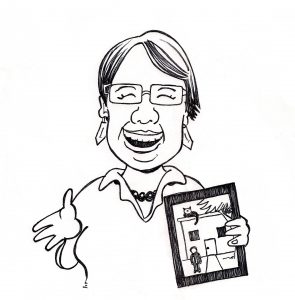
Happy Neurodivergent Pride Day

Today, 18 June, is neurodivergent pride day. Big yay to that! So, what do neurodivergent people have to be proud about? Well actually quite a lot. I can’t speak for anyone else but pride for me is about survival, respect and sharing my perspectives with a world that doesn’t always appreciate or understand them. I am a very proud autistic and ADHD (also known as AuDHD) person. However, this was not always the case.

I was diagnosed as Autistic in 1994 when I was twenty. The other thing to know about twenty-something Yennski is that they were a prisoner with some pretty significant drug issues and a very negative attitude. They masked and camouflaged in order to survive as an autistic prisoner. When my younger self received their autism diagnosis, they really didn’t like it – or accept that it was correct. Surely they were a big tough criminal? Yup, I was so good at masking that I even convinced myself. Pride was a long way off!

It took me seven years to accept my autism and a further eight years to properly embrace it as a core part of who I am. For a long time I was more comfortable telling people I had been in prison than I was to tell them I was autistic!

Thankfully there were some lovely positive influencers in my journey who helped me to come to a place of pride. The main one was my former autistic mentor Polly Samuel (who is sadly no longer with us). Polly supported me to write my first book – this we s a huge step on my road to acceptance and pride.  My parents were also really helpful. So now I am extremely out loud and proud as an AuDHD person, author, advocate, consultant and influencer – and human servant to my feline overlord, Sunflower the naughty tortie!

We all carry our own history and journey to pride. While the expectation seems to be that autistic people getting a diagnosis immediately embrace it and have a sense of pride this is not always the case, and that is actually OK. My own story demonstrates this. We all walk our own path.

I am now extremely proud to be me and embrace and celebrate my neurodivergences. I am proud of a number of things about my neurodivergent self. These include:

  • Determination
  • Empathy
  • My various ‘gifts’ and twice exceptional skills
  • My love for nature – and cats!!
  • My work as an advocate
  • My wonderful Yennski books – all 18 of them!
  • My neurodivergent peers and friends
  • My creativity
  • The fact that I have overcome immense barriers to get to where I am
  • My various Queer identities

So, to all my neurodivergent friends and compatriots I say get your pride on! Of course, every day is neurodivergent pride day in my house – and it should be everywhere. But having a specific day is a great way of highlighting our reality and the great insight, value, power and strength we so frequently bring to the world – Or just the fact that we exist as neurodivergent people and all that migt entail  So go forth, be proud, change the world and be your own wonderful and amazing you.

And this image is a historic Yeme so says Autistic pride day – I don’t have an updated one for neurodiversity pride day but you get the picture!!

Thoughts on object permanence and autism

I had the absolute privilege to MC a presentation by autistic advocate and author, my friend and co-author, the wonderful Dr Wenn Lawson today. I always love seeing Wenn present as he is a fantastic speaker and has a wealth of knowledge in a number of areas. One of Wenn’s areas of interest and significant expertise is the concept of object permanence.

What is this you may ask? I asked Google which provided this explanation: Object permanence means that you know an object or person still exists even when they are hidden and you can’t see or hear them.

Clinicians used to think (and many unfortunately still think) that autistic people lack empathy meaning we can’t understand what others are experiencing.

The idea of autistic people not lacking empathy per se but instead having difficulties around object permanence is a view which has more recently been adopted and to my mind offers a more accurate – and more inclusive – view. This suggests that autistic people are not aware that someone or something exists if we cannot ‘see’ them. Some people worry that their family and friends don’t exist until they are actually standing in front of them. My own experience of this is that if someone is late that I think they won’t turn up and I will be waiting forever. And I think if someone doesn’t respond to an email or message that they are never going to do so. Mixed in with my impostor syndrome and rejection sensitive dysphoria and you can probably imagine the resultant stress. In fact, I am stressed about this right now!

I will explain… I am working with an organisation that I haven’t been working with for long. I had to amend a document and send it back. The manager has not responded yet. Logic tells me she is probably busy or doing something else. Despite logic, I still called her and she didn’t pick up the phone – this catapulted me into thinking I had somehow offended her! This is an object permanence issue. Without reassurance, I assume that the employer will stop working with me and all sorts of other dire things because I cannot hold that event or relationships in my mind. I assume the opportunity will just disappear. I call myself the follow up fairy because I am a shocker for following things up for this very reason.

The anxiety caused by object permanence issues can actually damage your career and relationships. Many years ago I was invited to give a keynote alongside Temple Grandin and Tim and Judy Sharp. This was early in my advocacy career and I was absolutely delighted and very excited about this opportunity. However, I could not ‘see’ the event so I needed reassurance from the organisation hosting the talk. I would have called them at least once every week often more than that! I wasn’t asked to do the presentation the next time it was held and I am sure my stressy-ness about it probably contributed to that decision by the host.

And I do need to talk about empathy here because understanding around these things is closely related. Autistic people have all sorts of different experiences of empathy. Some people have very heightened empathy and can pick up on the feelings of people around them as is by osmosis. Some autistic people are highly thoughtful and kind. And then some have low empathy. Often we have ‘better’ empathy for other autistic people and less for our neurotypical peers. This does not mean we lack empathy – far from it. In fact neurotypical people tend to have less empathy for autistic folks than they do for their fellow neurotypicals.  Autistic academic Dr Damian Milton has written and presented widely on this through the concept of the double empathy problem.

I find my object permeance issues quite frustrating and wish I could just relax for a little bit and know that the most likely reason is usually the correct one and just because I can’t keep it in my mind does not mean it doesn’t exist or isn’t going to happen. For example conference organisers are almost certainly not going to change their minds and cancel my talk on a whim but I am always worrying about this because I cannot ‘see’ the event or my participation in it!  Even if I can’t see it, I don’t really need to constantly reassure myself that everything is OK, my work still exists and people are still there even if they do not remind me of that all the time.  

I think we need more understanding of object permanence as it explains a lot about the experience or many autistic people.

And here is a link to Dr Wenn Lawson’s website: https://www.buildsomethingpositive.com/wenn/ and Wenn’s YouTube site: https://www.youtube.com/channel/UCD8L-Ht_jSQxBmWe6MzZvJA  

My thoughts on rejection sensitive dysphoria and also why I am finally embracing my ADHD  

I recently came across a new term – Rejection Sensitive Dysphoria. What is this you might ask? Well, a quick Google tells me that: Rejection sensitive dysphoria (RSD) is when you experience severe emotional pain because of a failure or feeling rejected. This condition is linked to ADHD and experts suspect it happens due to differences in brain structure. Those differences mean your brain can’t regulate rejection-related emotions and behaviors, making them much more intense. 

I actually think it isn’t just ADHDers who experience this. I think a fair number of autistic people – and others – probably do too.  

The description of RSD sounds so like me you wouldn’t believe it! I am terrified of criticism and feedback. Receiving constructive criticism is one of my absolute least favourite things! It makes me stressed, catastrophise and makes my self-esteem take a nose-dive. I don’t even like waiting for what I am fairly certain will be positive feedback! And making errors and mistakes fills me with dread. While part of my message as an author and advocate is for people to make positives out of failure and setbacks, I am not always following my own advice. It makes professional employment very challenging – and was a large contributing factor to me recently leaving my previous job.  

A lot of people don’t understand this condition. They see it as a character flaw or something which can be changed through willpower alone. However, I know that I cannot change this part of being me just by applying some positive thinking – if I could I most definitely would as rejection sensitive dysphoria is very unpleasant and potentially very limiting. 

However, if it is a part of ADHD, it can probably be viewed as primarily a negative one. I can’t speak for anyone else, but I actually quite like my ADHD as it involves lots of really nifty attributes which make it possible for me to do the things I do. 

The positive qualities I experience are… 

  • Enthusiasm and optimism 
  • Humor 
  • Creativity 
  • Unconventional thinking style 
  • Hyper focus  
  • Imagination  
  • Excitement    
  • ENERGY!!!!! 

These qualities are just lovely. And the best one is the affinity I feel for (most of) my fellow AuDHDers. AuDHD is I guess another neurotype – and quite a common one, I think. I keep meeting more AuDHDers (and if you have not; come across the term is means a person who is Autistic and ADHD. There are lots of us!) 

While I do rather like my ADHD, I don’t think I understand it the way I do my autism – I’m looking forward to a journey of discovery in that space. It is hard to separate out the elements of my ‘me’ that are ADHD and which are my Autism. I am both things. I suspect it isn’t really possible to reliably separate them out. This is because AuDHD is probably not autism + ADHD rather it is a complex combination of the two neurotypes. In fact, I think it is probably a completely different neurotype – something which is ‘more than the sum of its parts.’ I have heard other people talk about the idea of an AUDHD neurotype too.  

Many adults struggle to obtain an ADHD diagnosis. There are a lot of pervasive stereotypes around ADHD such as it is only for children / boys, that ADHDers are ‘rude’ and enfage in crime and anti-social behaviour and that the diagnosis is just an excuse for poor behaviour. I think the understanding of ADHD in adults is at a similar stage to where understanding around autism in adults was ten years ago. I think a lot of adults in the coming months and years will seek an assessment for ADHD and there will be more knowledge on the topic in both the medical world and also in wider society.  

I look forward to learning more about this both from my own experience but also others’ – and maybe there will be some research literature in this area soon as well?  

I will share this with you… 

I have been talking about autism and employment for over ten years now. Whenever I present the topic to employers, I tell them that autistic staff members are often amazing at attention to detail. While this may well be true, it is NOT true for me! My attention to detail is horrible. I am a big picture thinker and miss errors – especially typos – all the time! This – as I have learned – is more an ADHD quality. Oh, how I wish I had the typically ‘autistic’ approach to detail not the ADHD one! Despite that I forgive my ADHD – it didn’t mean it! (And I will doubtlessly miss a large number of typos in this post!).  

…And now I will go post this blog, have some dinner, cuddle Kitty and then probably do three hours of work then go to bed! Yup, the self-employed and hyper focus thing is going nicely 🙂

New adventures – doing things you love.

Yesterday I left my job after 17 years. This was A Big Deal and the result of a variety of things.

Despite wandering around the house the day that I gave my notice saying to myself ‘hah ha you’re unemployed!!’ I do have some sources of income. I am now – after 17 years – basically a professional autistic, ADHD, non-binary and Asexual advocate. I will be doing consultancy, coaching, writing and presenting as a job. My income will be derived from doing something I love. How absolutely wonderful. I am very excited – and a little anxious from time to time. I will wake up on Monday and not go to work. Wow!  (Well given how vague I am I will probably wake up on Monday and get dressed for work, walk out the door and remember just as I am getting on the tram!!)

I have five employers lined up so imagine I may actually get more work than I can manage! However, I have essentially been doing two full time jobs for almost 20 years so I think I should be OK.

My new life adventure gets me thinking about other people’s employment journeys.  The wonderful Barb Cook and I wrote a book called Planning your career through intense interests a couple of years ago. It is aimed at autistic young people and looks at using your passion to drive a career. The ability to pursue your passionate interests as your job is a lovely thing indeed. Goal setting and career planning strategies can help and identifying what skills and interests you have.

I wish everyone career success and the ability to use their paid work to pursue their passions. I am excited at my own career adventure. A job should be enjoyable and engaging. It should help people build their knowledge, skills and wisdom. It should support development and engagement and self-esteem.  People – including autistic people – should have the opportunity for career advancement if they want it and are capable. There is a pervasive view among some managers that they have done an autistic employee a favour by employing them and they should stay at entry level and be grateful for it. This simply isn’t true. As a public servant I was promoted twice in my career because I was capable of working at a higher level. Work should be inclusive and free from bigotry and hate and bullying.  Being in the workplace should provide a sense of being part of something bigger, of making the world a better place as well as the more practical things like providing an income.

Autistic people can have a range of challenges in the workplace – often due to a lack of understanding from managers and colleagues. I had a boss once who when I raised my concerns about her ability to manage me as an autistic person said ‘Oh I know all about it. I managed an autistic person once’. These sorts of attitudes are sadly quite common. However, the workplace does not need to be an unpleasant place for autistic folks. We tend to have some impressive skills which set us apart from our allistic and neurotypical peers. I have worked in areas where I was highly prized due to some of the attributes which were related to my autism. I have been talking about autism and employment and the benefits of neurodivergent staff to employers for over ten years and it is a great thing to open their minds to the significant benefits of employing autistic staff. In fact, one of the things I will be doping in my new career is working with employers to support them to employ neurodivergent staff. Lovely!

People should want to be at work and should ideally look forward to going in to work. Of course, this often isn’t the case, but it can happen, and should be supported. Some of the best jobs I have had have been wonderful not due to the work itself but due to the managers. I once had a neurodivergent manager who was amazing. I had another manager who I loved dearly and am still in touch with after she retired many years ago. A good manager – or a bad one – can make all the difference at work.

I am happy to have had a 17-year career in the public service and I look forward to what the future may bring. When I was 25 – half my age now – I changed my life dramatically. Now I am doing it again. Scary and exciting. We will see how things go.

Oh, and as I am no longer a public servant, I can say this… I have politics! I vote Green! I really do and I always have. And I have an immense dislike of Pauline Hanson and Donald Trump and hope they both go to jail for a long time, and I think the world needs to fundamentally adjust its approach or we will all suffer major effects of climate change!! Ah, that felt good after 17 years!

Yenn at work

Twenty years – my journey to ‘ordinary’ (and beyond)

I was at a book launch last week – not one of mine but one for my friends Graeme Simsion (or the ‘Rosie Project’ fame) and his wife Anne Buist – also a wonderful author. They were launching their latest book, the best-selling The Glass House, set in a psychiatric ward and the protagonist of which is a registrar psychiatrist. I did a sensitivity read for the book – and can strongly recommend it by the way! My friend, neurodivergent advocate, co-author and all-round legend Barb Cook was there too, and we went out for dinner after the launch. While we were having a very tasty dinner complete with some very decent wine, I reflected that twenty years ago if you had told me I would be having dinner at a wine bar in Canberra with a group of three fellow authors I would have been, well quite surprised.

Twenty years ago was 2004. I was not an author; I did not live in Canberra, and I certainly didn’t have dinner with bestselling authors at a wine bar and to be able to navigate a menu at such a place. In 2004 I was living in public housing, I had a stalker among my neighbours and most of my socialising involved getting utterly trashed with my alcoholic neighbours. I wasn’t really an alcoholic myself in the usual way but I was desperate to be accepted socially and my neighbours were alcoholics so in order to fit in I drank excessively – impressively excessively! It was a difficult time. I was coming out of many years of criminal behaviour and drug use, and my life was something of a challenge.

However, I was also aspirational. I had ruined my life ten years previously by getting involved with a criminal and ended up in jail. It turns out to be very easy to wreck your life but a lot harder to get it back on track. In 2001 I decide dot make for myself an ‘ordinary’ life (such as having a job and a mortgage)  and by 2004 I found myself in two worlds – the criminal / druggie / alcoholic world inhabited by my neighbours and my past self and the very different world of university and aspiring to get a career and move out of the ‘ghetto’. In 2004 I was in my honour’s degree of a Fine Arts course. I was getting some renown in the Melbourne art world. I had some memorable experiences where I invited my alcoholic neighbours to high-end galleries for openings of my exhibitions.

I knew what I wanted: I wanted my life to magically transform into one where I was financially independent and where I was respected and could wear nice clothes. The odd thing was that this was actually just around the corner. In 2004 I was asked to participate in a training course with 20 other autistic people to be able to deliver talks about autism to school students. Mark Haddon’s novel The Curious Incident of the Dog in the Night-time (the central character of which is an autistic boy) was on the Year 12 book list at the time. The local autism employment service saw an opportunity to find  employment for its clients in giving talks in relation to the book. I went to the course and was amazed. I had never been around groups pf autistic people before. It was just wonderful and I felt at home. One of the other participants was an autism world celebrity, autistic advocate and author Polly Samuel, author of many books including the bestselling Nobody Nowhere. I was instantly entranced by Polly and her books. We became friends and soon I had the best mentor and aspirational autistic person could ever have.

Polly said I should write my life story. People had said this in the past and I always thought no way. I really didn’t need a bunch of people judging me for my dodgy past life and poor choices. However, Polly convinced me by saying that if I wrote my life story it would be for the parents of autistic young people who get caught up in the criminal justice system and who feel ashamed to engage with the other parents. Of course this related to my own parents, so I wrote the book.

I thought the book would make me a millionaire instantly. It so didn’t. I mean it REALLY didn’t! However, it did something better in that it changed my life, and it changed how I viewed myself. Three months after it came out, I applied for professional roles in the public service and was successful.

Nineteen years later and here I am. Friends with lots of other authors, proud of myself as an autistic and ADHD author and advocate, someone with a large following and with lots of respect in the neurodiversity and Queer communities. Twenty years ago, the life I have now would have seemed utterly preposterous, but it happened, and I am mostly quite enjoying it. I now have 17 published books with a further four planned, I have given talks all over the world including two for TEDx Canberra. Not many people have two TED talks! I am mostly in a good place and I like who I have become. My thirty-year-old self in 2004 would have been pretty happy with where they ended up, I think.  I used to want to be ‘ordinary’. I wanted to be like all the other people in the world who hadn’t been in prison and abusing drugs and alcohol.  I actually don’t think attaining ‘ordinary’ was within my capability. I suspect that these days I could reasonably be called ‘extraordinary’. There is an old song that I like, ‘What a difference a day makes….’ For me I guess it is what a difference twenty years makes. I am actually quite proud of how I ended up getting a life beyond my wildest imaginings. Oh and did I mention that I have a wonderful cat? I do.

…And while I am here, buy Graeme and Anne’s book because it is awesome!!

ADHD and me

I think everyone knows I am autistic but maybe less people know I am ADHD. A lot of people with both diagnoses call themselves AuDHD which I quite like and suggests that the combination of both is in itself a distinct neurotype.

It can be almost impossible for adults to get a diagnosis of ADHD. I was very fortunate in that I had a psychiatrist who was an expert in ADHD, and I was already seeing him, so he did the assessment during our regular sessions. Unfortunately, he also prescribed me with the medication for ADHD which is dex amphetamines. I spent a week or so feeling wonderful on the meds and being more focussed and competent that I was like a different person. Unfortunately, the medication triggered my psychosis as I have atypical schizophrenia! So, the meds were definitely not for me which was a shame because that week of being medicated was amazing!

While I am considered something of an expert in autism I am less so in the field of ADHD. What I know about ADHD is pretty much based on my own personal experience and knowing that – as with autism – all ADHD folks are different.

There are a lot of myths and stereotypes around ADHD including that it is a diagnosis for poorly behaved kids, that only children are ADHD and that ADHD folks are all criminals and make poor choices and are driven by impulse and lack any concept of consequences.

There are different sorts of ADHD including inattentive and impulsive and a combination of those. I am mostly inattentive which for me means I struggle with attention to detail, get easily distracted and am very forgetful and vague. The odd thing about those attributes is that they are at odds with my autism. Autistic folks are expected to have good attention to detail but ask any of my former or current managers and they will tell you that my attention to detail is pretty horrible! I need to put in place a bunch of strategies to address this and especially at work. I also struggle with reading big blocks of text which also impacts on my work. Thankfully I am quite brilliant in other ways!

In fact I have some lovely attributes related to my ADHD and my autism such as the ability to focus deeply, to make quick and well-informed decisions and my innovative approach to things. Plus I do creativity at a very high level. I have been told many times that I can write anything and my stage presence as a speaker is amazing.

I am still learning about my ADHD. Many people who are AuDHD identify more closely with one or other thing. If I was to pick one that I feel closer to in terms of my identity I would definitely pick my autism, but I understand that my ADHD contributes to who I am and how I experience the world as well.

One of my ADHD qualities which gets misunderstood is a very common one and something I struggle to ‘fix’ and that is talking over people. I have a relative who is most likely ADHD as well and whenever we have a phone conversation, we talk over each other! It is actually pretty funny, but I know a lot of people for whom this attribute is highly annoying. We can be perceived as rude which is probably not the case. It is a common attribute of ADHD folks though and one I think the world needs educating about to avoid us ADHDers being judged and considered rude or disrespectful.

A lot of ADHD adults are self-diagnosed due to the difficulties around gaining an adult diagnosis. There is a shortage of clinicians who diagnose adults, and the process can be expensive and it can be hard to find a clinician who does assessments for adults. For me it is helpful to have my ADHD diagnosis as it helps me to understand who I am and explain some of the challenges and triumphs I have had throughout my life. I did fulfil the stereotype of an ADHDer who has no idea of consequences and commits crimes because of this. It was very unpleasant – for me and for everyone affected. However, that was between 25 and 30 years ago and I am now very aware of consequences and can address the poor thinking and behaviour that I once took part in. I have become a highly ethical person. I think a diagnosis would have helped at that point in my life where I was making poor choices. In the current iteration of Yenn, ADHD is more about my identity than it is to understand my behaviour, but I am very glad to have the diagnosis.

So, to my ADHD and AuDHD readers, be proud of who you are and I hope your knowledge of who you are in your neurotype brings you joy and a big whopping sense of pride. I knew it does for me.  

Experiences of hate as an autistic Queer person – and why it is never OK.

CW suicide

I gave a TEDx talk last year. It was all about Autigender – that lovely concept where your autistic and gender identities are closely intwined and you can’t separate one from the other. Here is a link to the talk – because I love it!  

However, not everyone who watched it loves it. When I was giving the talk, I spoke on hatred and said that I knew – not wondered or speculated but knew – that when the talk went online it would attract attention from transphobic bigots. I secretly hoped that I got that wrong but sadly I was 100 per cent correct. Within 24 hours of uploading the video I had my first hater and they were closely followed by another. I honestly don’t understand these people’s motivation for this kind of thing and it is really not OK to attack me for my gender identity.

The weird thing about this kind of transphobia is that my gender – or your gender or anyone else’s gender – is nobody else’s concern. My gender has no impact on anyone else in the world so why do people that don’t even know me feel the need to level a bunch of hate and bigotry at me? I think the only instance where a person’s gender is potentially another person’s business is maybe in their sexual partner’s (as some people like and dislike certain physical characteristics in a partner) but I am yet to see transphobic hatred coming from trans folks’ partners!

Hatred in this space hurts, and it is dangerous. Many studies show that forty per cent of transgender folks have attempted suicide. Forty per cent! And bigotry and transphobia clearly feed into this horrific statistic.

I don’t hate myself when someone attacks me for my gender identity. I have two reactions. The first is anger. And that to my mind is the most appropriate reaction – someone has attacked me due to their own bigotry and ignorance. That is cause for an angry response from me and defending myself against an unreasonable attack. I should not hate myself about this but sadly a lot of people do. The other reaction I have is sadness. I am sad that a person limits themselves like this and that they don’t get to learn from and interact with awesome trans people.

I know that every time I post about gender diversity someone attacks me. They say all manner of things. My gender is apparently a sin, a phase, ‘madness’, ‘woke nonsense’ or unnatural. Weird because I thought it was just my gender! Do other people’s genders have all of this attached to them? Is my mum’s gender ‘political’? Is my dad’s gender the result of coercion? So then why is mine?  The transphobic bigots are a pretty passionate bunch which always baffles me. Once again why do they care? Do they feel threatened by me and my trans siblings? If that is the case, seriously why? They are even organised – whole groups of people dedicated to hating trans people just because we are trans. How sad does a person need to be to form a hate group or be a member of one?

Aside from outright hatred there are other issues I experience around gender. I am non-binary and my gender expression (i.e. clothes, hair etc) is androgynous but maybe more feminine than masculine. This means that as far as apparently most of the world is concerned I am female. This seems to be based on them taking a cursory look at me and then applying a stereotyped view of what my gender should be. I am NOT female; I am non-binary. Basically, I get erased all the time, called a ‘lady’ or ‘she’ even when I have stated my gender and pronouns. It isn’t as bad as outright hate but it is very frustrating and annoying. I wish people had more than two ‘boxes’ for gender! Thankfully I have some beautiful friends and allies who pull people up when they misgender me, but it is a major issue. A couple of years ago I even entertained the idea of going back to using she / her pronouns – for about five seconds – and then realised that I shouldn’t change who I am just because people kept getting my pronouns wrong!

I think a lot of people think things are better than they were for Queer folks and autistic folks in recent years. They are right – sort of. In terms of legislation and policy, in representation in popular culture and the collective consciousness things are very different to thirty years ago – or even 10 years ago. However, there is still a lot of things needing change. While we now have greater understanding of gender diversity for example, there are people who use this as a springboard for hate and transphobia. And the world we occupy is quite dynamic and the online world plays hosts to misinformation, conspiracies and all kinds of hatred so we do not know when a new conspiracy based in hate might crop up. There is no margin for complacency in this as it is far from guaranteed that things will change for the better in the future or that the gains that have been made will necessarily continue.

Hatred is everywhere which makes me sad and angry but thankfully so is acceptance and love.  In my TEDx talk I spoke on the concept of allyship and of cis gender folks standing on the same side as Autigender folks. Everyone can be an ally and it makes a big difference. Allyship and advocacy combined form a great counter to hatred and bigotry. There are people working to change the world in this space, to support people and promote inclusion and respect. I will note a couple of resources in this space:

Dr Wenn Lawson and Beatrice Lawson: Transitioning Together

Maxfield Sparrow (edited): Spectrums

Sabrina Symington: Coming Out Again  

Laura Kate Dale: Uncomfortable Labels

Yennski at Mardi Gras in 2019

Happy thirtieth birthday to my autism diagnosis

I was born in July 1974, but I didn’t know I was autistic for another twenty years – and I didn’t accept that for a further seven years. My autism diagnosis is now thirty years old so happy birthday!

When I was diagnosed, I was a prisoner (long story – visit my autobiography, Finding a Different Kind of Normal for more information on that part of my life.) I hated the diagnosis at that point in my life. I thought it was my middle-class parents making excuses for my poor behaviour and not accepting what I believed to be their influence on the troubled character I was at the time. I always knew I was autistic though; my denial was more about not wanting the diagnosis to be correct than a belief that it was wrong. Autism was very raw, very personal. I felt like it validated the bullies at school. And surely I was a big scary criminal not a nerd. (I actually believed autism to be a diagnosis of nerd!)

I got my act together in 2000. I got help for my mental health issues and decided to be a better version of myself. I enrolled in university which I loved. At the end of my first year, I got unwell with mental health issues. This prompted me to reflect on my identity. At this point I realised that for the first time in my life, that people actually liked me based on my personality and not because I belonged to one or another social group. I reflected on who in was and decided that the autism diagnosis in 1994 was probably correct. I did some research on autism and discovered Dr Wenn Lawson who is now a friend, colleague and co-author. I was still a fairly self-hating autistic though. I was more comfortable telling people that I had been in prison than my autism, but I was on a journey and that approach would soon change.

In 2004 I was asked to participate in a course for autistic adults to enable us to speak to school groups about autism. For reasons best known to herself, the very well-known advocate and author Polly Samuel attended this course despite the fact that she was an accomplished public speaker. I knew nothing about the world of autism advocates so didn’t know who Polly was. When we first met, she told me she had written nine books. I was amazed and wanted to be friends with this luminary in the world of autism.

Polly and I became great friends. In fact she became my mentor. I was delighted. Polly told me I should write my life story. She was not alone in this. At the time lots of people told me to write my life story and I categorically declined as I figured a book about my life would be met with judgement and blame and would make my life miserable! However, Polly convinced me. She said that if I wrote my story, it would be for the parents of autistic kids who got in trouble with the law. In half a second, I realised she meant my own parents, so I wrote the book. Polly also taught me autistic pride. I recall many occasions of making art in the studio at the bottom of her garden or playing with all her stimmy things. Polly enabled and encouraged my sense of autistic pride and positive self-knowledge. I remain and will always remain immesnely grateful for these things.

The book was published, as I am sure you know, and my career as an advocate began. Polly passed away a few years ago which was a very sad thing indeed. I think Polly gave me the life I have now. She was so hands on in her mentorship. The support she gave me with my first book was completely above and beyond expectations and without her influence I think the life I have now would be very different.

That was a long time ago now. My advocacy career is currently 19 years old. I have done some amazing things, met wonderful people and published another 16 books.  I have gone from being in complete denial about my autism to be out loud and proud and a bit of a poster child for autistic pride – and a bunch of other kinds of pride too.

So a big happy birthday to my diagnosis. I can’t imagine a world without that piece of paper. I actually lost the original piece of paper but I remember it said I satisfied all the DSM IV criteria for Asperger Syndrome so I think we can fairly confidently say I am autistic both in terms of formal diagnosis and my own sense identity. I have only met one clinician who thought I wasn’t autistic, and he tended to diagnose all the female patients in his hospital (and those he thought were female – like this non-binary Yennski) with borderline personality disorder (which I think he thought was histrionic woman syndrome, so I don’t take his dismissal of my autism very seriously!)

I wonder if I will be around for my diagnosis’ sixtieth birthday. An eighty-year-old Yenn is a scary thought – how many books will there be then?? I shudder to think.   But I do know that I love my neurodivergent identities and am delighted to have that autism ‘label.’ I have gone from being in denial to hating my autism to being extremely out loud and proud and wanting to make the world different – and better – for other autistic folks. And I guess I had better find thirty rainbow candles…  

Happy Mardi Gras!

I just called an awesome friend and in Sydney and she said she was at Mardi Gras and would have to call me back tomorrow! That is a pretty good reason to end a phone call and now I wish I was at Mardi Gras myself! I imagine my friend will have an amazing time. I have only been once myself in 2019 when I marched with the Aspect LGBTIQA+ folks. It was amazing. 2019 was one of the worst years of my life for mental health issues and when I got to Sydney for the event I was stressed and very depressed. I was worried I wouldn’t enjoy Mardi Gras but as soon as I got to Oxford Street the depression simply vanished. It was so affirming and empowering. I gave the crowd high fives the whole way and was blown away that all those hundreds of thousands of people were there to support and affirm me and my Queer friends and comrades.

Some Queer folks don’t like Mardi Gras and think is not radical enough and that it doesn’t help us. While I understand that view, I personally just love Mardi Gras as it gives us an opportunity to celebrate Queer lives and experiences. And let’s face it, as an activist I am a very good homeowner – I am pretty far from a Bolshevik these days!

Queer experience is obviously not just about celebrations though. I am Queer 365 days a year (and 366 this year!) One thing about being Queer is that you find out pretty quickly who is supportive and who is bigoted. I use they / them pronouns and when I introduce myself to someone, I feel I should tell them that to avoid me being misgendered and assumed female. (Unfortunately, this can happen anyway but coming out tends to reduce it a bit. People really do need to get across they / them pronouns!) I rarely encounter overt bigotry in response to my coming out but sometimes I do. When I came out as non-binary in 2018 a trans friend told me I would find out who my friends were and who they weren’t and that I would be surprised. They were absolutely spot on. Some people who I thought would react badly did, but some didn’t and some people I thought would be supportive were and some weren’t.

Some people think that non-binary isn’t a ‘thing’ or that it is all part of some woke agenda. I can clearly state that is not the case. My non-binary identity is very real indeed. I changed my name officially in 2019 and updated my passport to reflect this. Someone said you could get a gender descriptor of X on your passport and I thought that was a lovely thing to do so filled out the required form online. When it came to my gender, for some reason I needed a verification from my doctor about that. So, I made an appointment to see my psychiatrist. He asked me how I felt after I came out as non-binary. Without hesitation I responded that I felt liberated and that I wanted to dance down the street. So, guess who got gender X on their passport! I thought that was an interesting way to determine a person’s identity – how they felt about it – but I consistently feel liberated and comfortable in my own skin now I have my affirmed gender.

I am also asexual. This is an interesting one because it took me a while to figure it out and also to understand that it was a Queer identity much like being gay or bi is. I am now a very proud Ace and strongly identity as such. It is lovely knowing that there is an Ace community as well and that I am not alone.

A bit earlier in my LGBTIQA+ identity journey, before I had come out as non-binary or asexual, I was at a conference. We had drinks after the event, and I got talking to one of the other delegates. Out of the blue I said to them ‘I think I am non-binary and asexual’ and they responded with ‘me too.’ This was the first time I had tried to come out and not only was it positive, but it also affirmed both me and the person I was taking to. Affirmation and validation are essential things in this space, I think.

I could write so much on this topic. I haven’t even started on Autigender or Neuroqueer identities. I do have a TEDx talk on Autigender from 2023 which I would love to link to in this post, but the video hasn’t been uploaded to YouTube yet! I think the main take aways from this area are the value of pride and the immense value of being a genuine ally. So happy Mardi Gras good people of Yennski’s blogland, get your pride on and be your amazing self, whatever your identity may be.   

An amazing gift – Yenn’s parents

I am sitting in my parents’ dining room typing this post after being here since Saturday. I often say my parents are the best people in the world and here are some of the reasons why…

My parents are very much into church. When was a kid we went to the Christadelphians which is theologically quite conservative and fundamentalist. Over the years we all left the Christadelphians – me at the age of 15 and my parents some years later. In the circles I currently move in (transgender people and those with marginalised sexuality) Christians are notorious for being hardline, conservative and bigots, especially around gender diversity and sexuality. When I came out as non-binary in 2018 my parents were amazing. I was worried about them accepting me, but they not only accepted me, but they also actively demonstrated their love and acceptance. They even bought me a loaf of rainbow bread! In my TEDx talk last year, which was about gender diversity and autism, I said that my parents were the best kind of Christians imaginable and if all Christians were like my parents, then sign me up – I’m off to church!

My parents have always shown love and kindness and wanted the best for me. The ultimate demonstration of this was when I was a prisoner. As you may know. I was a prisoner from 1994 to 2000 on and off. My parents visited me every month. When I was released, they would help me move – this happened many times. They never judged and were always there for me. I remember them saying that there were no other middle-class parents and me saying that they had all stopped coming. When I first went to jail in 1994 it came as a surprise to my parents. They stayed with a wealthy friend in Melbourne. She said, ‘if that was my child I would move to Peru!’ My mum since said she was pretty certain this person actually would have moved to Peru! Thankfully my parents stayed in Victoria where it was easier to visit me than in Peru!

When I say I was in prison, I think people imagine it was like the movies. It wasn’t. I was the most broken and unhappy person you could imagine. I was violent against myself and others. I was considered a management problem and given a lot of punishments and sanctions. I wanted death. My life was total hell and everyone – including my parents – thought I would be leaving prison in a box. The anxiety my parent must have felt when I was going through all this must have bene off the chart. I wish I could make it up to them, but I guess my current success in life is a way of practically demonstrating that.

When I was released for the last time in February 2000 my parents were amazing and supported me like you wouldn’t believe. I remember them going overseas about three months after I was released and coming back with loads of gifts of me. They still love giving me gifts and every time I see them, they have some little treasure for me.

My love for my parents is immense. I think they are totally wonderful, and I also think they and their actions of support and acceptance are the main reason I am still here and that I am making a difference in the world. So, thank you to my parents for everything.

.